Sunday, 26 January 2025

#5 Theresienstadt model town in the Holocaust ...

The name Theresienstadt is familiar to me because it comes up as the birth place for several of my ancestors so I was keen to learn more about it & to be able to put an image to the place name.  

My knowledge of its time during the Holocaust was patchy because the Holocaust is such a vast topic spread over much of Europe with hundreds of camps so you cannot know the full details of each & I was keen to know what role Theresienstadt had in the Holocaust. 


On a cold October morning, we entered the pretty town, passing the small walled fortress, parking up then doing the short walk to the walled fortress.  We were greeted by many graves of the National Cemetery where victims of the Gestapo Police prison,  the Terezin Ghetto & the death transports from Litomerice concentration camp were buried individually & in mass graves. A large cross & Star of David stands amongst the headstones. 

The small walled fortress became a Gestapo prison in 1940

The Small Fortress had the character of a transitional prison, where the prisoners were being gradually sent to concentration camps. Around 2,600 prisoners were killed in the fortress through hunger, torture and poor hygiene. Thousands died after being transported from Terezín to concentration camps and elsewhere.


Another guide joined us & he took us around the fortified castle where Jews from all over Europe were held. 

Reinhard Heydrich's reputation followed  us again from Prague to here as he decided at Wannsee that Theresienstadt would house prominent Jews over the age of 65 & those who were too high profile to be transported to other camps where they would be missed. To deflect attention, Heydrich attempted to model Theresienstadt as a spa town, a caring place where Jews were safe. 

At the Wannsee Conference on 20 January 1942, Heydrich announced that Theresienstadt would be used to house Jews over the age of 65 from the Reich, as well as those who had been severely wounded fighting for the Central Powers in World War I or won the Iron Cross 1st Class or a higher decoration during that war. These Jews could not plausibly perform forced labor, and therefore Theresienstadt helped conceal the true nature of deportation to the East. Later, Theresienstadt also came to house "prominent" Jews whose disappearance in an extermination camp could have drawn attention from abroad. 
To lull victims into a false sense of security, the SS advertised Theresienstadt as a "spa town" where Jews could retire, and encouraged them to sign fraudulent home purchase contracts, pay "deposits" for rent and board, and surrender life insurance policies and other assets

We were shown a propaganda film that was made at the time showing life there as idyllic & safe. 

Theresienstadt was a hybrid concentration camp and ghetto established by the SS in November 1941 in the fortress town Terezín, located in the Protectorate of Bohemia and Moravia (German-occupied Czech lands). It was simultaneously a waystation to the extermination camps, and a "retirement settlement" for elderly and prominent Jews to mislead their communities about the Final Solution. The harsh conditions were deliberately engineered to cause the death of prisoners. Of the approximately 155,000 people sent to Theresienstadt before the end of the war, 35,000 died at the ghetto from hunger and disease and 83,000 perished after deportation to various ghettos, extermination camps, and other killing sites. The ghetto was run by the Council of Elders headed by the "Jewish elder", which was responsible for implementing Nazi orders

We knew that this was not true & the inhabitants had to put on a show for the Red Cross & later for the International Red Cross to hide the treatment of people in the Ghetto.  It was not something they could refuse to do under the dangerous circumstances. 

The conditions & rooms we were shown were similar to other sites we had been, including the familiar Arbeit Macht Frei sign over the courtyard entrance. 

In the late 1960s, East Germany arrested Kurt Willi Wachholz , a former Small Fortress supervisor. Wachholz was convicted of war crimes and crimes against humanity for participating in the murders of over 300 prisoners, some of whom he personally beat, stoned, kicked, and drowned. He was also convicted of complicity in the firing squad executions of at least 183 people. Wachholz was sentenced to death in 1968, and executed at Leipzig Prison on 28 April 1969.


I had crossed paths some years back with Gavrilo Princip who assassinated Archduke Franz Ferdinand, his wife Sofia & their unborn child in Sarajevo & this was the catalyst for the start of WW1. I had not expected to cross paths with the imprisoned assassin in Theresienstadt & where he died in an isolation cell. 

History really does cross countries & sometimes we are fortunate to be able to connect names & events which gives a better understanding of the complexities of war & peace, of winners & losers ... 


The walled fortress once again echoed the brutality of the treatment of its mainly Jewish prisoners - the executions by bullet etc. From here many were transported to Auschwitz, Riga etc with very few surviving the camps.  

We crossed in to the town to visit the excellent Ghetto  museums set over several floors before carrying on down the pretty streets to the Magdeburg Barracks building set up as a memorial to that time of history, the rooms show the crowded conditions under which the transported had to live & survive. 


 On 24, 27, or 28 June 1943, DRK representative Walther Georg Hartmann and his deputy, Heinrich Nieuhaus, were allowed to visit the ghetto, guided by German Foreign Ministry official Eberhard von Thadden They confirmed the delivery of Red Cross supplies and secured permission from the SS that overflows would be sent to other camps, especially Auschwitz concentration camp. In his report, Hartmann described the ghetto's conditions as "dreadful" and "frightfully overcrowded"; the prisoners were severely undernourished and medical care was completely inadequate. 

Of all Red Cross reports on Theresienstadt, Hartmann's was the only one to be broadly accurate. Hartmann leaked his impressions to ICRC official André de Pilar, who in turn reported them to the ICRC in Geneva and to Gerhart Riegner, secretary of the World Jewish Congress in Geneva, directly in July 1943. Contrary to SS expectations, the visit actually increased DRK suspicions about the Nazi extermination program.

The exhibitions also show that many were artistic people, musicians etc, then back out on to the pretty streets for a walk to the Jewish cemetery that had ovens to dispose of the dead. The large cemetery with its Star of  David a sobering reminder of the dark history that played out on these now pretty streets. 

We respectfully covered our heads for the trip to the Jewish cemetery on the side of town with the large Star of David & it crematoria where the dead were. 

A monument was built & a memorial site laid out to commemorate the liquidation of the bigger part of the cinerary urn that contained the ashes of the victims cremated in the Jewish Cemetery Crematorium. In November 1944, the ashes were thrown in to the Ohre river & the urns were burnt to hide the deeds.

It was a sombre scene being so close to the crematoria & several of us lit candles & said prayers ...  


It was very interesting to be able to put images to a place name that I knew through my family history research, how the decisions made in Wannsee stretched far across our tour, effecting many nationalities & towns across Europe. 

Thank you for stopping by & allowing me to share this with you on the 80th anniversary of the liberation of Auschwitz, cherish peace, 

Dee

#4 Operation Anthropoid & Reinhard Heydrich

 We crossed paths with the SS Obergruppenfuhrer Reinhard Heydrich at Wannsee Conference where he decided on the Final Solution to deal with the Jewish Problem

He was brutal & worked with Himmler - both brutal SS officers. 

He helped organise Kristallnacht, a series of coordinated attacks against Jews throughout Nazi Germany and parts of Austria on 9–10 November 1938.

In Prague, we followed the story of his assassination by the Czechoslovakian Resistance movement who planned & executed a hit on his vehicle, not well carried out but enough to injure him & for him to pass from his injuries.  

Heydrich was mortally wounded in Prague on 27 May 1942 as a result of Operation Anthropoid. He was ambushed by a team of Czech and Slovak soldiers who had been sent by the Czechoslovak government-in-exile to kill him; the team was trained by the British Special Operations Executive. Heydrich died from his injuries on 4 June 1942.

However, this led to a brutal & violent backlash, particularly against the communities who were massacred in reprisals. 

Nazi intelligence falsely linked the Czech and Slovak soldiers and resistance partisans to the villages of Lidice and LežákyBoth villages were razed; the men and boys age 14 and above were shot and most of the women and children were deported and murdered in Nazi concentration camps.

The story of the resistance fighters who were holed up in the Cathedral of Saints Cyril & Methodius still bares the bullet scars & the small museum next door told their story. 

In 1942, during World War II, the cathedral was where a last stand was made by SOE-trained Czech and Slovak agents involved in the assassination of SS-Obergruppenführer Reinhard Heydrich. SS and Police Leader of Waffen-SS Karl Fischer von Treuenfeld commanded the Nazi forces that stormed the church on 18 June 1942. After a fierce gun battle, two of the Czechoslovaks were killed and the rest committed suicide to avoid capture

The stairs up in to the church


The church was interesting; the priests were conscious of the need to preserve the spirituality alongside this story. They were preparing for an evening service & their quiet faith gave the church its purpose.


The cellars with the images of the brave soldiers who stood up against the occupation is sobering. 


A really interesting day getting the details of this assassination, the story of which we had followed from Wannsee. It is fascinating how history overlaps in places, how ordinary people take up the cause & how widespread the repercussions are. 

Thank you for reading this part of the Holocaust's story across Europe, be thankful, 

Dee 

#3 Krakow & Oskar Schindler's holocaust journey ...

 Our tour moved on to Krakow & the part of Oskar Schindler in the Holocaust. His story is famously told through Schindlers List - that epic film with the haunting music by John Williams.  65 000 Jews were murdered in Krakow so it was an important part of the Holocaust tour. 

Zgody Square became part of the Krakow Ghetto  & the empty chair installation a powerful reminder of the loss to family tables thenceforth. 

The 33 oversized Empty Chairs each represent 1000 lives lost here 

Note the Ghetto wall that was built in the shape of Jewish grave headstones to surround the area where the population was confined to. They felt entombed by the walls. 

The Ghetto space had previously housed 3,000 Poles, now 15,000 Jews were cramped in to the same space. Food rations were meagre & many died of hunger & cold. 

We walked the streets that formed part of the Ghetto, astounded by the incarceration of so many. 

The Chemist shop museum on the corner of the square remains as a tribute to Tadeusz Pannkiewicz, a gentile who kept his pharmacy open & kept the embattled ghetto population supplied with medical care. 

He also helped Ghetto Jews with news of what was happening outside so they had an understanding of the war.

His Rightious Amongst the Nations medal is on the wall of the Pharmacy. 


It was in Zgody Square that selections would be made; decisions that for the residents of the ghetto meant life or death. Those selected to leave the ghetto were boarded onto trains and sent either to Płaszów, Belzec, or Auschwitz. Some would not even make it to the train; the elderly, sick and young were often executed in the streets, in their homes, or even on the square itself. An order to empty the ghetto completely would soon be given. This troubling chapter in the Square’s history is captured in Stephen Spielberg’s Schindler’s List. Most of the residents would meet their end in the gas chambers of Auschwitz Birkenau, or worked to death in the camps of Płaszów and Belzec. The square nonetheless, would be rendered painfully empty following this order.

The Ghetto was surrounded by Nazi built walls in the shape of Jewish headstones, some of the wall still visible that we walked around with our guide. The numbers held in the ghetto was huge & Oskar Schindler's factory is not far from it. 

Oskar initially used Jewish labour because it was cheap labour, however, in time he came to realise the reality of the cheap labour & his attitude changes in dangerous times. Once he decided to help the ghetto population, he saved more than a thousand lives. The Ghetto was liquidated on the 13 March 1943 when the Nazi's murdered 8,000 of the 15,000 Ghetto Jews, others were transported to camps. 


The factory is timed entry & the various rooms & floors showing the war as it moved across Europe. There were so many interactive things along the way, parts of which had visuals & sound effects - a very immersive & interesting experience. 

To stand in Oskar's office was humbling, it was from that space that they plotted how to keep their Jewish workforce safe at great personal peril. 


   The desk in Oskar Schindler's office where they worked out how to make their workers 'irreplaceable' & how to keep them from being transported as the Ghetto was cleared. It was dangerous times to stick your head above the parapet when the whole city was under Nazi control. 
As with all these holocaust experiences, it can   overwhelm & at one point on the undulating, trench like floors with barbed wire & sounds, my friend became overwhelmed & started to hyper ventilate. As a teacher, I went with my first instinct & took her arm, found the exit with fresh air & helped her to calm her breathing. 

 We know the story of the factory from the graphic Schindler's list, so the reality was intense. A cool drink & chocolate in the little café helped while we waited for our group to join up again. 

Walking along the tombstone like ghetto wall is a reality check, how fortunate we are to live freely now. The wall looks like the gravestones it is meant to be. 


Our next stop was the area so familiar from Schindler's list - the Plaszow concentration camp

It is surreal to pass the house shown in the film where Amon Goth, the brutal Austrian camp leader, ruled with terror & violence, often shooting people from the balcony of his home that overlooked the camp. His time as camp leader is shown in graphic detail in Schindler's List - someone who wrought untold misery, violence & death to the incarcerated camp inhabitants.  Commandant Goth (Goeth) oversaw the liquidation of the Krakow Ghetto, some of the inhabitants moved to Plaszow or transported to Auschwitz. Those deemed unfit to work were shot on his orders at Plaszow.  

"Evil may well be nearer the surface than we like to admit" (Ralph Fiennes as Emon Goth)


To stand on the very ground of Plaszow camp was humbling because you knew you were standing on the ground where so many had lost their lives, had their lives & spirit shattered by an ideology. Many were shot for simply not working hard enough or for other minor reasons. 

If someone tried to escape, 10 prisoners were shot as reprisal. This camp was brutal & both men & women guards were known for their violence towards those there. 
 
This earth is soaked in historical blood, of terrible violence & suppression ... 


The historic Jewish district of Kazimierz was our last stop for the afternoon with its Synagogue, old Jewish cemetery that had been destroyed & the buildings looked familiar because they had been used in Schindler's List. 

Musicians played along the square, Jewish tunes familiar from my early life in Johannesburg with its large Jewish population & influence.  

We enjoyed this historic setting that belied its recent dark history. 

We relaxed over supper at the many cafe's on the square, enjoying the Autumn sunlight, the music, vibe & atmosphere of this pretty place,  its dark past within sight all the time if you know where to look.  The Jewish culture is very much part & parcel of this space today as it always had been.

An excellent short youtube video explains more about Krakow & The Holocaust 

Thank you for taking time to read this & to possibly reflect on it .... 

Dee 

#2 Berlin's holocaust journey ...

We all have things that stick in our minds & the historic images of the book burnings across Berlin was one such thing for me.  Books by Jewish & other authors, including Einstein, Karl Marx, Helen Keller etc  were deemed 'un German' & were piled up in the square between the university & burnt. 

I knew of the event & the images but a stop & short walk to the spot was so important to me who values education. The book burning memorial at Bebelplatz is set below ground level - a room with empty bookcases that you look down on - a powerful memorial that needs no words. 

To stand on the spot I knew about from history was momentous for me. 


The quote by Heinrich Heine came to mind at that spot "Those who burn books will in the end burn people." 

Some familiar Berlin scenes - The Brandenburg Gate, the Freedom Statue, The Pope's Revenge Cross on the TV tower, the Olympic park where Hitler presided over the Olympics ... 


The Popes Revenge - when sunlight hits the TV tower, it reflects a cross out across what was East Germany where religion was banned, a small act of defiance by the architect. 


The Berlin visit took us  to the infamous Wannsee Conference centre, in an exclusive area on to the stunning lake. It looked idyllic with beautiful views but it was here where The Final Solution was signed off,  as 'meeting followed by elevenses' without another thought.  

Walking in the same rooms as the SS plotters & Reinhard Heydrich  was surreal because we know the impact of the decisions made in this space & how it would fuel the Holocaust.  Reinhard Heydrich chaired the meeting that 15 people took part in - leading members of the SS, state secretaries from the government offices, the party & the Reich Chancellery. The Gestapo official responsible for the deportations was Adolf Eichmann, who took the minutes of the meeting.  He escaped after the war but was captured & trialled in  Jerusalem in 1960/61.  Notes from that meeting, identifying the numbers of the Final Solution.


Our tour crosses paths with Reinhard Heydrich again later in Prague where we visited the church of Operation Anthropoid & how he met his death through an assassination ... 


We stopped at a small railway siding at Gleis 17 & on its platform are metal markers of all the transport trains that left from this unassuming siding to camps all over. 

The dates, destination & numbers on the platform plates on both sides is sobering, a reminder of the mass movement & extermination of people in the Holocaust. By the end of the war, more than 50 000 Jews had been deported from this one station in the Berlin suburbs. 


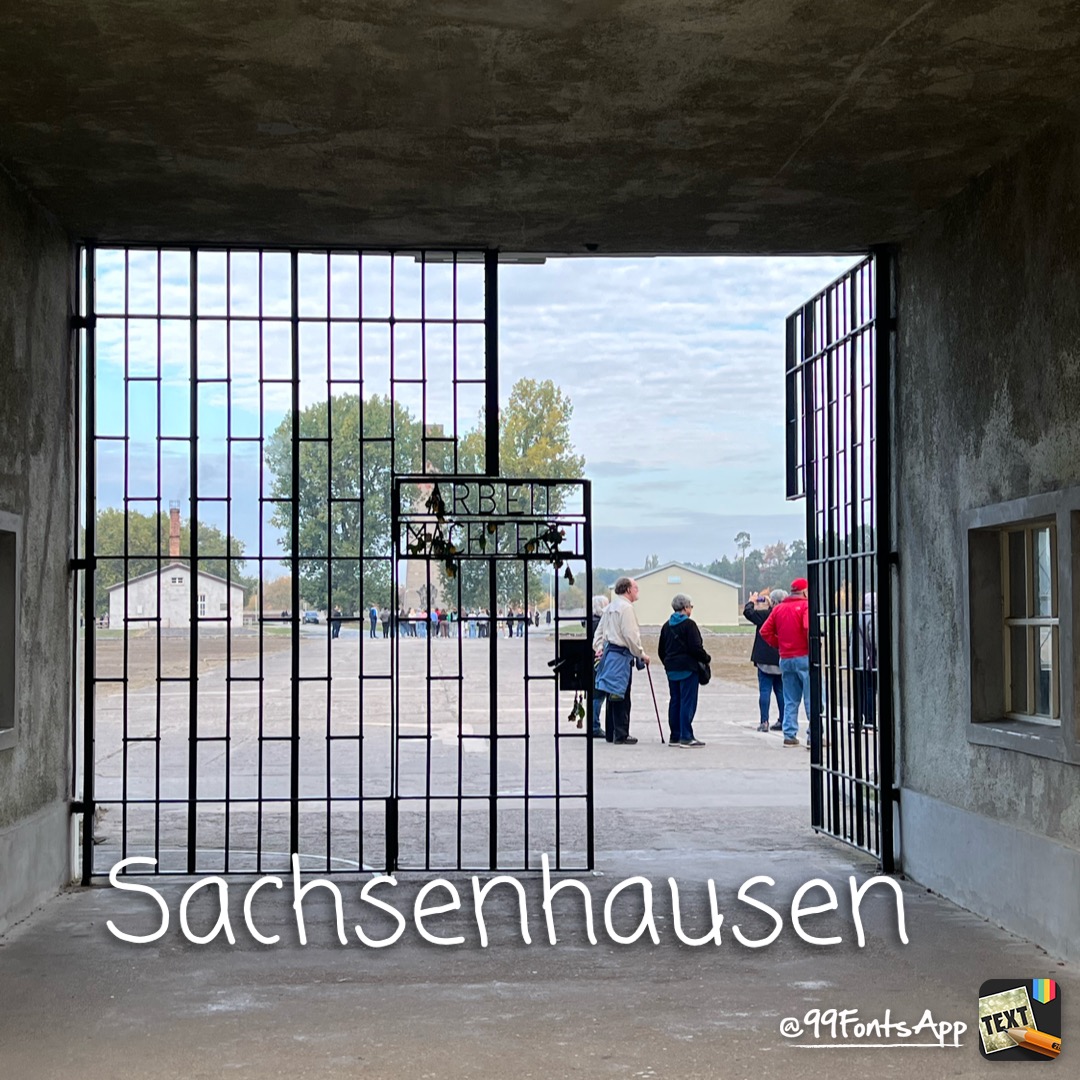
The next stop was the vast Sachsenhausen Concentration camp. 


Sachsenhausen was the camp I knew the least about on the tour but it was also one of the most impactful, entering under gates with the familiar slogan of Arbeit Macht Frei (work makes you Free).  It held mainly men but also a smaller number of women & children,  political prisoners, including many Russians & it was at this camp that they trained SS officers for other camps. 

They did medical experiments & it was the earliest use of gas chambers & crematoria, the originals still there, protected by a roof. The area outside this space holds the ashes of inmates that were dumped there or thrown in the river - they will never have a named resting space. There is also an execution firing ramp where prisoners were shot. The camp held & executed thousands of religious prisoners,  homosexual men, Jehovah Witnesses, political prisoners etc The lists grew on a whim - no one was really safe. 

   We walked out of the main camp to the side camp & read the etched boards & the scale of the depravity was hard to take in, the site atmosphere is heavy with residual energy, with hanging being done regularly on gallows while they were lined up for roll call, where executions were common on the ramp area, where ashes were disposed of in the river or in pits.  The camp contained various sectors - the roll call area, the shoe testing track (where prisoners were forced to walk round & round testing leather for the German shoe industry), the prison within the camp ruled over by the Gestapo, a place veiled in secrecy & torture, the execution trench, the industrial yard where enforced work was done, the Soviet camp  with mass graves of at least 7,00 people etc 

Badges of all colours marked out the various people in the camp ... 


We walked back in silence to our coach, stunned by the scale of the camp & its killings.  


The lunch stop in the pretty Polish town of Wroclaw, formerly the 'Festung' defended town of Breslau, was a reminder how the whole region was drawn in to the war.  Breslau had historically been part of the Kingdoms of Poland, Bohemia, Hungary, Habsburg Empire of Austria, Prussia, Germany before becoming part of Poland again after 1945. What a complicated history this city had through all those changes over the centuries, a reminder how wars change regions ... 

These breaks were essential as we gathered in small groups to chat, socialise & normalise our day.  The resident military specialist tour guide with us make sure we were all coping with the intensity of the tour, an important consideration with so much darkness.

Thank you for taking in this dark history, knowledge is power, 

Dee 

#1 Following in Anne Frank's holocaust journey ...

World War 2 with its far reach across Europe & how it effected even my family right down on the Southern tip of Africa reminds me how interconnected we are. 

I first heard of Anne Frank & her diaries when I was studying German in high school & a neighbour lent me an LP box set of records detailing her diary. It was in German & I found it hard going but my maternal grandfather spoke German as one of his home languages - his Father had been born in Germany, now Poland, and his Mother was Dutch.  So we sat together on a weekend after Sunday lunch & we would listen together & grandpa would then give me the gist of the matter as he understood German better than I did. He had served in WW2 as part of the massive South African effort & it was a time frame that brought tears to his eyes, the conflicts of culture, of his heritage. 

I had previously visited some Holocaust sites in Riga & in Warsaw  & the Shoes along the Danube in a Budapest 


I decided to join an Anne Frank & Oskar Schindler specialist tour before Covid postponed it for 3 years.  That part of Europe is ingrained in my DNA & I do not understand the deep connection. I travelled as a single but knowing one of the other ladies from a previous trip.  There were several single travellers because it is not a tour everyone feels the need to do, but those who do, have their reasons.

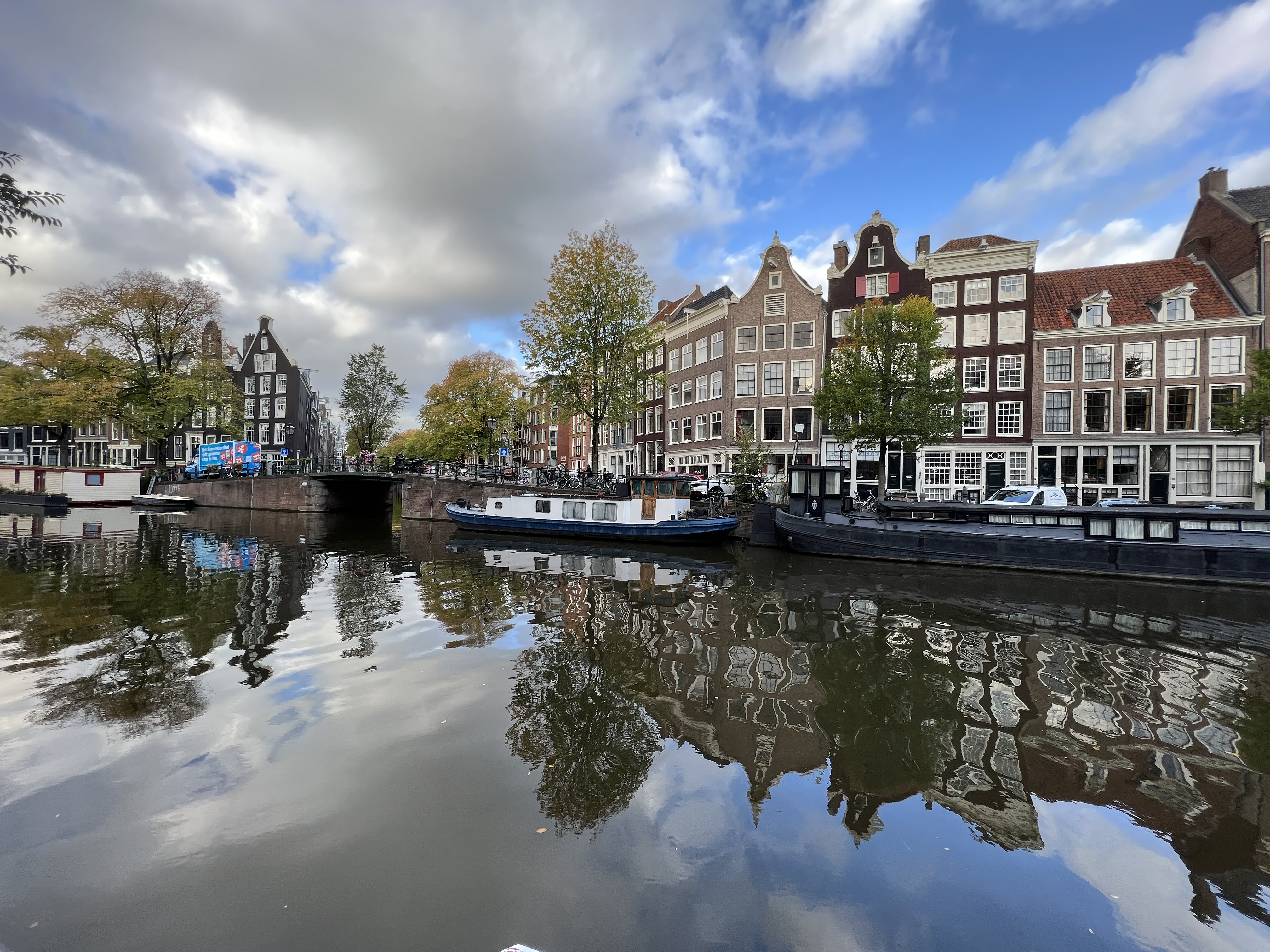
Our first stop was in Amsterdam, at the unassuming building along a pretty canal. 


The church near the house, Anne wrote about being able to hear the bells & see the tower. 


A statue near the church to Anne Frank 


Repairs on the front of the building during our visit. 


I had passed it some years before on a boat tour & even though this time it was scaffolded it was surreal standing outside & walking along the same streets which held such dark memories within living memory for some people. 

The sunshine & pretty gabled homes made it even more surreal.  I knew from her diaries that I have read several times with my students too, that she could hear the church bells & see the pretty church tower, that voices could be heard from the street, the tree in the garden - it was all familiar through her stories of the 25 months they spent in the Secret Annex. 


From there we traced their journey once captured to Westerbork Concentration Camp (still in Holland) where they were separated in to a secure space because they had been in hiding. The camp Commandants house is preserved under a glass cover, with perfect views over the train tracks & camp - the trains left regularly & an electronic board now tells of the number of people on board, their destination & the dates. A sobering reminder of the use as a transit camp. 


Transport trains arrived at Westerbork every Tuesday from July 1942 to September 1944; an estimated 97,776 Jews, Sinti and Roma were deported during the period. Jewish, Sinti and Roma inmates were deported in waves to Auschwitz concentration camp (65 train-loads totaling 60,330 people), Sobibór (19 train-loads; 34,313 people), Theresienstadt ghetto and Bergen-Belsen concentration camp (9 train-loads; 4,894 people).  Almost all of the 94,643 persons deported to Auschwitz and Sobibór in German-occupied Poland were killed upon arrival.


From there her story continues in Auschwitz but that part of the story came later for us because Anne's journey doubled back from Auschwitz to Bergen Belsen where she died.  

How bleak Bergen Belsen looked on our October morning, the sun barely warming the vast area. 


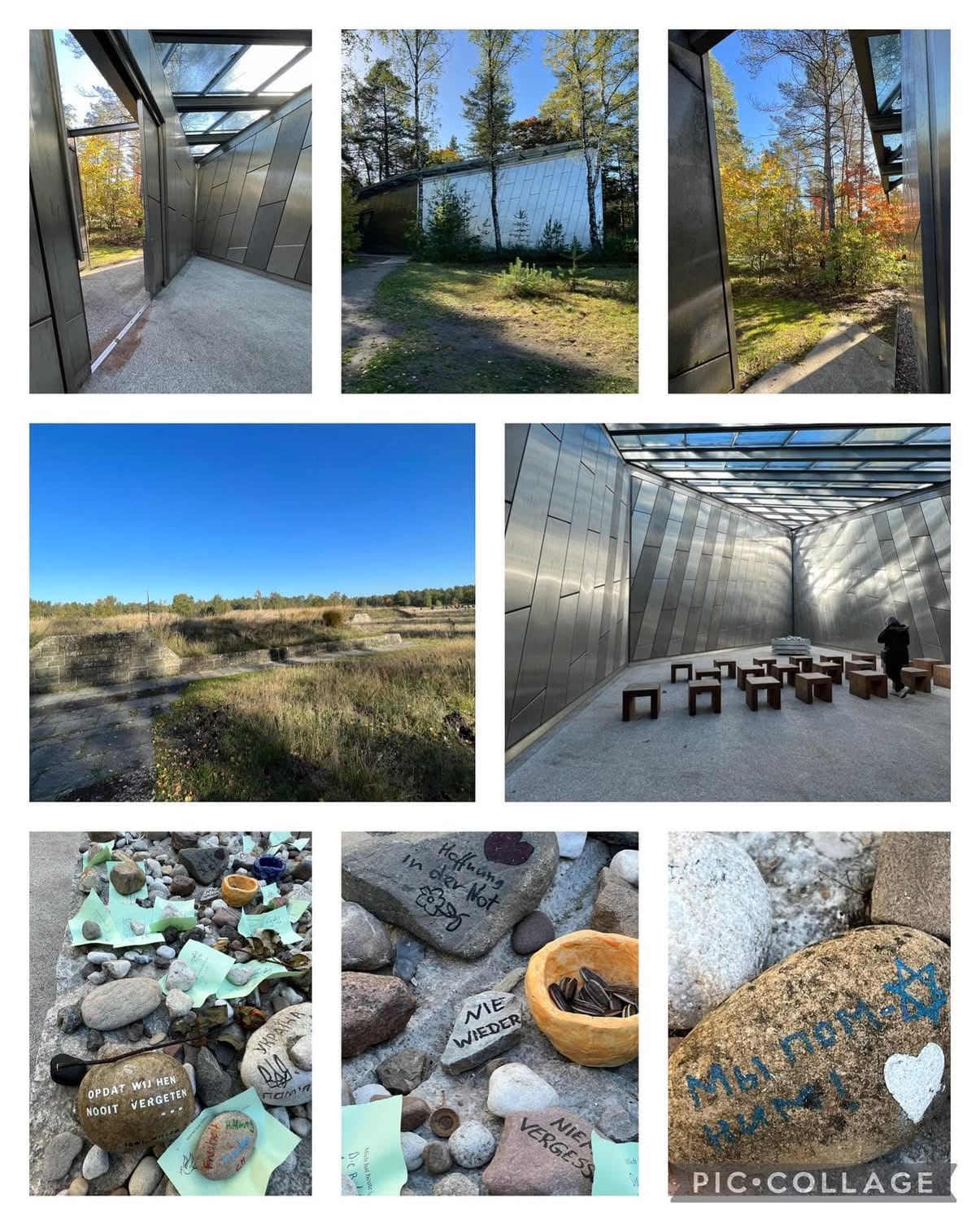
There was a real sense of despair & sadness in this vast area & the 3 ladies I was with & I retreated to the quiet chapel space along the wooded edge to gather our thoughts & selves - it is overwhelming to be moved to  silence in this place of evil.  

In this space, people had left stones with messages & we sat on the chairs & just gathered our thoughts. The weight of history is heavy at Bergen Belsen & you cannot escape the depth of the deeds that permeated this space. 


I was unprepared for the size of it & the huge brick edged burial mounds - the details given as a date & number in each mound of mass burials. Margot & Anne, the Frank sisters, like some others, have a memorial stone but their remains are contained in one of the mounds, which one is unknown.  


Stones last longer than flowers, the Jewish tradition of leaving a stone to show you have been is evident on the memorials here, people moved to marking that they had come & paid respects ... 


Nothing can prepare you for the sight of these vast burial mounds that had been pits dug to contain the huge numbers of dead. After the war, they were edged with bricks to contain them & the numbers were added to each one. There is a real sense of despair here in this space,  of history needing to be told, of death & suffering of the more than 52 000 who died there ... 
  

The excellent museum at the entrance gives much background to the Holocaust & to the life of Anne Frank, glimpses in to the life of an early Anne doing ordinary things with her friends. 

After the intensity of Bergen Belsen, we had a welcome lunch stop in Celle. It is a pretty traditional town & we could regroup & chat amongst ourselves. 

We then travelled on to Berlin, a city I have visited 3 times previously as part of general tours. I love the buzz of the city. I have previously visited parts of the war aspects of Berlin but each time I gain something new from this amazing city. I love that after several trips, I can pick out the landmarks & the streets feel more familiar. 

The story of the Nazi’s echoes across Berlin. 

I had previously visited the large stone memorial - Memorial to the Murdered Jews of Europe in Berlin - their solid shapes set on undulating paths, which gave you the feeling of helplessness, of not seeing the whole picture, of being part of something much larger.  
This time, being early morning,  our guide set us off to go alone in to this vast concrete space, to have ten minutes with our thoughts, to move about it as we wanted to & then to gather again & share our thoughts. It was interesting how everyone described the experience - some saying overwhelming, others lost, some intimidated by the tomb like structures that tower over one. It is an interesting memorial that does not tell you what to think or feel, it is open to interpretation   ....  


The new Topography of Terror museum is set along part of the Berlin wall. While setting it up, they uncovered interrogation cells along the wall that had been used by the SS during WW2. 

The information boards tell the story of how the war impacted so many communities across Berlin. Definitely worth the time there & it also has a very nice coffee shop where we could meet together at the end again as a group. 

It was then a short walk to the old railway station where so many were transported from. We passed a bunker that was set over 7 floors high, including 2 basement levels.  It is now open to the public to gain insight in to the many bunkers that protected the elite. 


A short walk from the Topography of Terror exhibition took us to a side street & then to stand on the spot of Hitler's Bunker - now under a carpark. 

 It is fitting that the bunker where Hitler died is merely marked by a board & not preserved at all, it is right not to mark this spot where so much evil was contrived from. 

Standing on the spot was surreal, knowing the history Hitler & Eva Braun. 

There was a palpable sense of walking in dark history along this walk. 

Along the Brandenburg Gate is stone markers in the pavement to show the position of the infamous Berlin Wall that separated the city, the Reich Stadt close by & the history there all contributed to how Berlin was the centre of the war.

 Walking along the remaining wall further in the city was a powerful reminder of how quickly events overwhelmed families & how quickly life can change. 

Checkpoint Charlie a visual reminder of the period after the war & how close yet how far the communities were in their divided state. 


More to follow ... 

Dee