Showing posts with label Myddle. Show all posts

Monday, 12 May 2025

An original ducking stool ...

I know I shared this in the previous post  on the Welsh Marches / Shropshire churches but I feel it deserves its own story. 

St Peter's Church in the pretty village of Myddle just oozes old charm - the tiled floor, the black roof beams in a lovely pattern, the font in the bell tower, the list of Rectors stretching back almost a 1000 years, it all speaks of being the centre of a community, of history & continuity. 

However, I did not initially take in the importance of the wooden chair up high on the wall, out of reach above a cabinet. 

At first, I did not recognise it as such, but while reading the 'Short history of the church' booklet on the way back to the car, I realised what it was - a ducking stool. I had never seen an original one which is why I did not register what it was. 

I just had to return to do a better photo & to take in the history of it because I was quite shocked to see it in St. Peter's Church in Myddle

Myddle is one of the ancient Shropshire villages named in the 1086 Doomsday book, a type of early census which took account of people, livestock etc. 

Some early history of the village of Myddle 

The village of Myddle was occupied by 1066, with a manor house for Siward, Earl of Northumbria completed in the 1050s.[3]

By 1086, the year of the Domesday Book under William the Conqueror, the manor house was occupied by Rainald the Sheriff. During the 12th century, the Fitz Alan family of Clun occupied the manor house, with John Le Strange acquiring it around 1165.

In 1234, Myddle was the location of the signing of a treaty between King Henry III and Welsh Prince Llewellyn.

In September 2005 and September 2007 a detectorist uncovered a small number of hammered gold coins dating back to the 14th century.

The Le Strange's dynasty ended in 1580 due to the lack of male heirs to the estate, and Myddle passed to the Thomas Stanley, 1st Earl of Derby after he married Joan Le Strange. Their son, Thomas, became the second Earl of Derby.

Elizabeth I granted Thomas Barnston a licence to sell land in Myddle in 1596, and in 1600 Sir Thomas Egerton purchased the village. Egerton's son was created by James I the first Earl of Bridgewater in 1617.

During the English Civil War in 1642, Charles I recruited 20 men from Myddle, with 13 killed

Myddle suffered an earthquake in 1688, but continued to expand throughout the coming centuries, with butchers' shops, taverns, fishmongers and masons inhabiting the village by about 1850.

With such a long history, there will be outdated practices but ones which were in keeping with the times. 

Ducking stools were medieval chairs used to publicly punish,  humiliate & censure women for offences such as scolding, sexual offences such as illegitimate children, backbiting, prostitution & more. 

They were enforcement of social norms through public humiliation. Some were humiliated after mass through the public reading of their 'sins'

The construction of the chairs were usually of local manufacture with no standard design. Most were simply chairs into which the offender could be tied and exposed at her door or the site of her offence. Some were on wheels like a tumbrel that could be dragged around the parish. Some were put on poles so that they could be plunged into water, hence "ducking" stool. Stocks or pillories were similarly used for the punishment of men or women by humiliation.

The number of duckings was determined by the magistrate who presided over the sentence.   

Usually, the chair was fastened to a long wooden beam fixed as a seesaw on the edge of a pond or river. Sometimes, however, the ducking-stool was not a fixture but was mounted on a pair of wooden wheels so that it could be wheeled through the streets, and at the river-edge was hung by a chain from the end of a beam. In sentencing a woman the magistrates ordered the number of duckings she should have. Yet another type of ducking-stool was called a tumbrel. It was a chair on two wheels with two long shafts fixed to the axles. This was pushed into the pond and then the shafts released, thus tipping the chair up backwards. Sometimes the punishment proved fatal and the subject died.

These were grim times for women who had no rights of their own, they were at the mercy of the men around them. Look at the images on wiki to see how the chairs worked

The use of ducking stools during witch trials which gripped England in ancient times is better known. They would be tied to the chair or hand to foot & plunged in to water. If they floated, they were guilty (in league with the devil) if they sank (drowned) they were innocent; so either way they died. 

These were grim times indeed & being so close to one in a church was really sobering. I knew of the dark history of the chairs, especially during the witch trials, so it was, for me, a moment to reflect on how far we have come to entrench women's rights. 

An ancient object which symbolises so much. I hope you have found this account interesting too, thank you for stopping by, reading  & leaving a comment too.  

Dee 

Sunday, 11 May 2025

Exploring some Shropshire Welsh Marches towns


Shropshire has so many little towns & villages & I know the South Shropshire ones of my great great grandfather quite well as I visit them frequently. 

However, on a beautiful Sunday, we packed a light picnic lunch & headed to the villages near Shrewsbury. along the Welsh Marches that we don't know too well, even though they are closer. Hubby photographs local churches & adds them to his enormous contribution on google maps so he is always keen to share local history widely. That will be our legacy one day ... 

St Peter's Church in Myddle has a Doomsday plaque - the community is recorded in the Doomsday Book 1086.


It also has a list of Rectors  from 1086 (Priest  not recorded) and then from 1232 the Rectors are listed due to impressive record keeping. Their names will always be remembered because they are written & openly shared like this. 

I love to pick up the 'Short History of ... ' booklets in churches & this one mentioned a Ducking stool so I doubled back to take note of it. 

Ducking stools are rare - and this one is connected to a local pond where women were publicly humiliated or ducked. 

The stools were technical devices which formed part of the wider method of law enforcement through social humiliation. A common alternative was a court order to recite one's crimes or sins after Mass or in the market place on market day or informal action such as a Skimmington ride. They were usually of local manufacture with no standard design. Most were simply chairs into which the offender could be tied and exposed at her door or the site of her offence. Some were on wheels like a tumbrel that could be dragged around the parish. Some were put on poles so that they could be plunged into water, hence "ducking" stool.

It is sobering to see it on display in a church, a place one associates with compassion. 

Ruyton X1 towns is an unusual collection of 11 parishes (hence the name) It contains the remnants of a medieval castle too. 

Mentioned in the Domesday Book of 1086 as Ruitone, the village acquired its unusual compound name in the twelfth century when a castle was built, and it became the major manor of eleven local townships. The earliest occurrence of the inclusion of the Roman numeral for eleven in the name is stated to be 1379

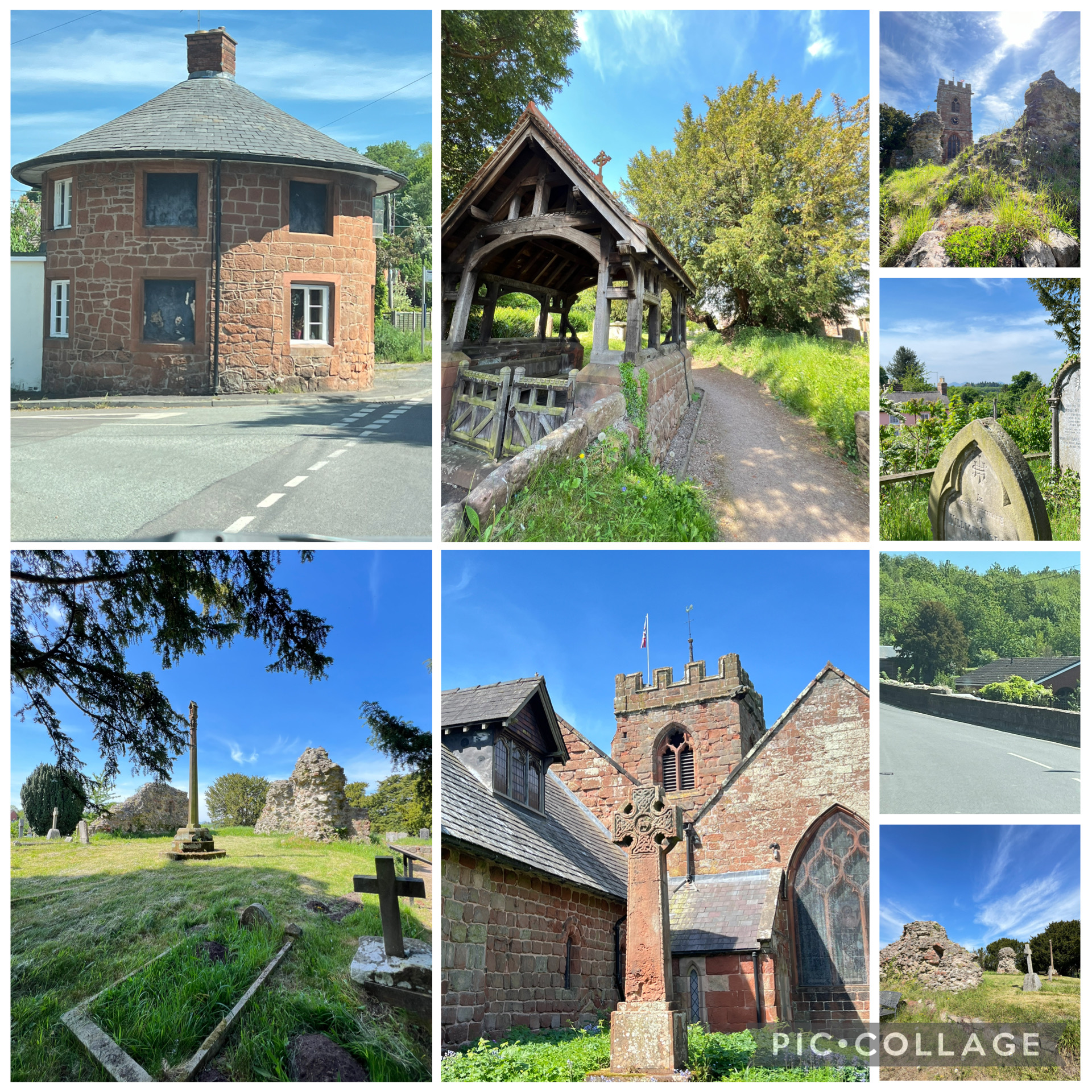
Once again, it is mentioned in the Doomsday Book. The church has a Lych Gate from 1888, erected in memory of the Vicars two sons who died within a year of each other. An ancient Yew tree stands next to it. 


The Church Tower has an impressive gargoyle on it & a plaque noting that the seats in the church are free, unreserved so an indication that all are welcome. 

How lovely it all looked against bright blue skies with wispy clouds. 

Can you see the horned devil in the bottom left? Someone had a vivid imagination. 


Heavy studded doors to the church & another set to the entrance. The stained glass windows cast their colours across the space & somehow they seemed brighter in the sunlight. 


Some views of the town & across the Shropshire hills  ... 

There are some stone remains of the castle & they frame the church well, a reminder of the long history of these towns & how they were fought over in the Marches border wars. 

St John the Baptist Parish church is fascinating with its raised bell tower platform in the church, the 12th century Norman Arches & a rather graphic medieval carving of a horned head, said to represent the Devil on an arch next to some pews.  

There is also the remnant of a 13th century stone coffin found during earlier excavations in 1892. The East window, known as the Hunt Window was painted in Munich in 1855 & it shows the children being blessed. The figures of the 2 girls were reproduced from portraits of them. Rev George Hunt commissioned them in memory of his children who died between 1831-1832. 

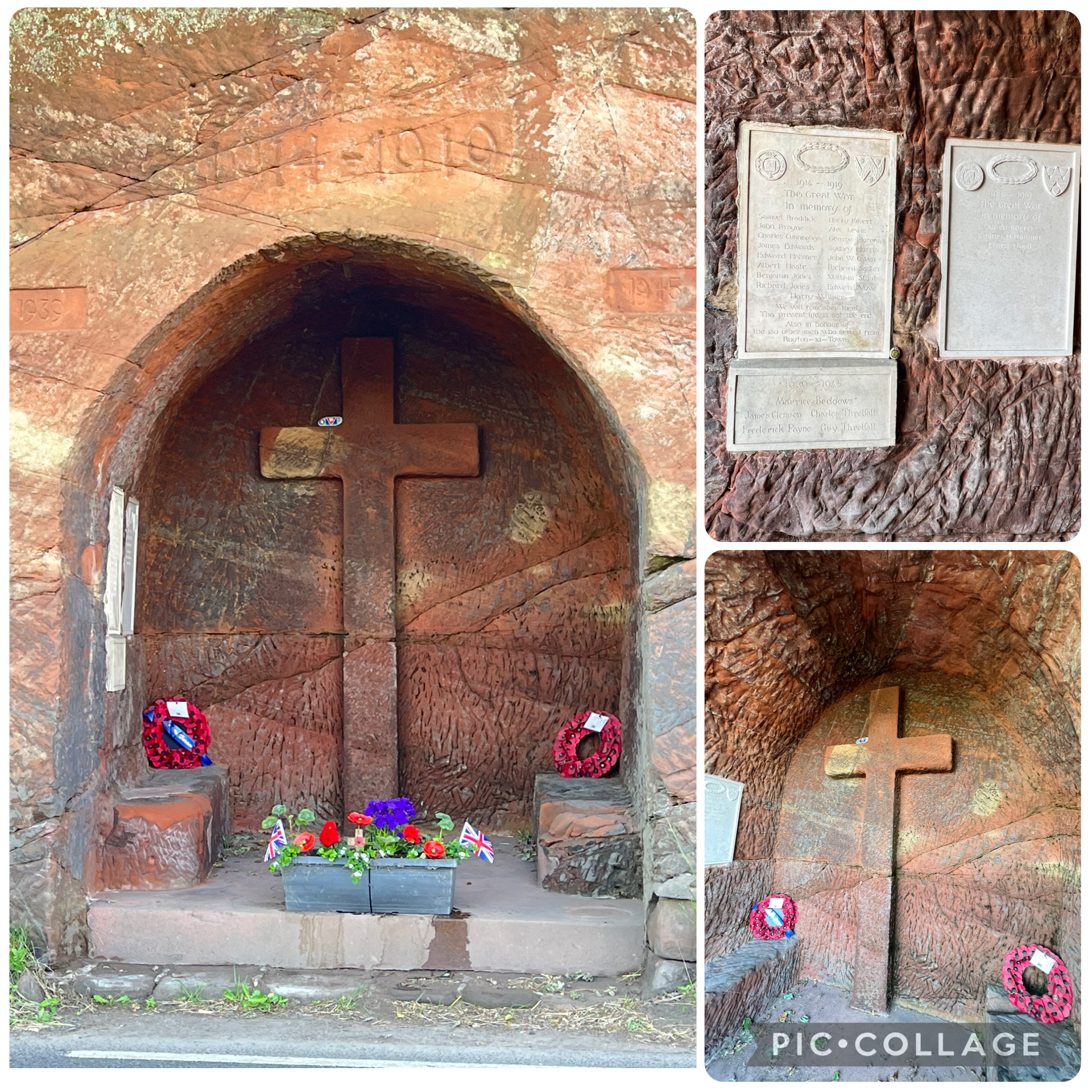
The town of Ruyton X1 has an unusual War Memorial set in stone along the road

The parish's WWI war memorial is an 8 ft (2.4 m) carved cave within the sandstone cliff of the Brownhill. Located beside the road leading out of the village towards Baschurch, it is unique to Shropshire. It was conceived by the London architect Stanley Vaughan after a visit to Ruyton, and created by local father-and-son stonemasons Warwick and Len Edwards. The benches within the arch and the cross are all carved out of the rock. The memorial was unveiled in October 1920. The names of fallen from both the First and Second World Wars are listed on plaques within the archway. A third plaque, to an Alfred Rogers, was added in 2007 after he had been omitted from an earlier plaque

It has the names of the towns war dead from both World Wars. 


St Martin's church of Little Ness is a red sandstone church set in tranquil countryside nearby. A service had just ended & we were given access to this modest by beautiful space by 3 church wardens who filled us in on the connection to the Darby family of Coalbrookdale / Ironbridge. 


St Martin’s was built on a mound in the 12th century as a chapel to Baschurch. It consists of a nave and chancel within one roof, with a bellcote at the west end. The circular font is Norman, as is the south doorway and there are some patterned mediaeval tiles in the chancel. There are war memorial windows to two men killed in World War I, Leonard Arthur (killed 1914), and Lieutenant Maurice Darby (killed at Battle of Neuve Chapelle 1915). The latter is buried in the churchyard, one of a few Englishmen killed at the Western Front whose bodies were repatriated.

It is a beautiful space, one that feels spiritual & welcoming, the window to Maurice Darby is a beautiful one to remember a son who died on a battlefield far from home. Opposite the window is another to an uncle. Maurice was killed & his uncle who was serving at the same time, with help, recovered his body & repatriated it. This was unusual & controversial because only 6 bodies were repatriated, the rest are all buried in exactly the same graves across Europe - no distinction given to rank at all because the ethos is they all died serving their country. The Darby graves by the door to the church are a link to local history & their contribution to the communities. 

 To the side of the church is a large ancient mound or barrow. It has been suggested it marks the resting place of the Cumbrian Prince Kyndylan who died in battle in the 6th century. However, this is only conjecture. 

We had our picnic lunch in the shade of the lane by the church with frothy white cow parsley & vivid yellow rape seed as companions.  


Our final stop was All Saint's Church, Baschurch. The church is mentioned in the Doomsday Book & in February1188 & again in March 1198. The acclaimed Engineer Thomas Telford had a hand in its restoration & it is an important example of his earlier work. 

According to an ancient Welsh poem, the church may be the resting place of Cynddylan, a 7th century prince of Powys. There is an ancient earthwork nearby called the Berth.

The church tower is c13 with 4 bells that are at least 400 years old. 


There are two 18 century sundials on the wall & are discernible in the stonework with a central hole for the peg. These would have been important when country folk did not have timepieces. 

The yew tree near the east end of the church is thought be between 500 - 800 years old & is held together with a metal band.  


I hope you have found out countryside history & pursuits interesting - we enjoyed the 1000 years of history across these ancient places.  Thank you for stopping by & spending time. 

Dee