Saturday, 21 June 2025

A colourful supper to start to Summer …

It is a bit of a tradition to embrace bright colours in summer. Ours is so short lived;  the warm days & long nights are a joy after winter. 

I'm having friends join us for supper, not dinner. For me, supper is a relaxed get together with generally only a main & pudding. It is a time to catch up on each others busy lives. Dinner is a bit more formal & is rarer. 
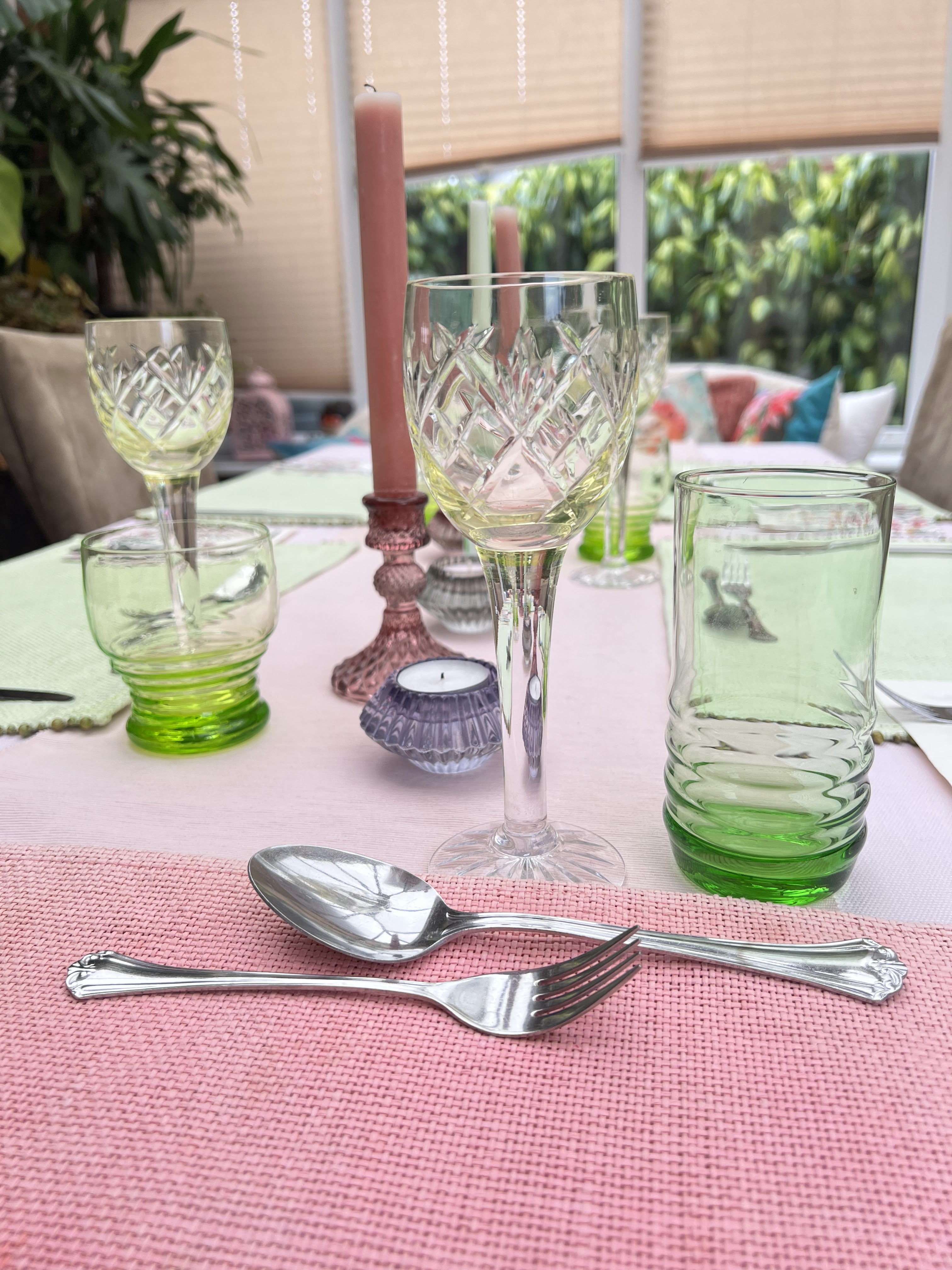

However, I still love to set the table. It was my ‘job’ as a child to set our long dining table for 7 each night or more if friends & grandparents were joining us. Supper was always at the table at home & it was a time to catch up on each others day in the era of no mobile phones.

I digress; pink table cloth & runner, green & pink placemats,  green tinged wine glasses & green glasses & jug that belonged to Olive. 

It is always fun to have lots of candles & my coloured glass ones do very nicely. Taller pink & green holders & smaller tea lights in pink, green & blue -  summery & fun. 

It has been a hot week so the menu is planned for a lighter meal with interesting salads. 

It is strawberry season so Eton mess  & fruit compote will be served in coloured vintage glass bowls. 

I think it is a good choice for a solstice meal that is wholesome without being heavy. 

What would your ideal mid summer meal be?  The updated Solstice menu is blogged here ... Thank you for stopping by, it is appreciated. 

Dee 🥗☀️🏡🫜

Marking our Summer Solstice …

 And just like that, we have arrived at our summer solstice on the 21st June.  Longer brighter days are here with late sunsets & lazy evenings as the sun is reluctant to set until almost 10pm soon. The darkness is banished for a time & we have to embrace the light & colour. 

My garden is bursting with colour & even though I try to keep to pinks, purples & blues, the reds & hot colours appear too like punctuation marks in the garden. 

It is a space we love being in. Our large tree provides much welcome shade on hot days & cools the air at night so the breeze in the house provides welcome relief. 

This green space is calming & I feel a little smug that I am doing my but for the wildlife who make themselves at home  Green spaces cool urban heat islands so it is great for the environment too.

I made an iced lemon verbena tea today with herbs from the garden & sat in my green space, grateful for blessings. 

On the Solstice, I always reflect on the past 6 months & decide in my head how I want the rest of the year to be. Set intentions as the light returns in its full power for summer. I think having supper by candlelight is always good as the flickering light is gentle & provides space to think. I am hosting friends tomorrow on Solstice Day with fresh food & lots of candles. 

So much can change in the 6 months to the next solstice in the dark mid-winter so use this time to enjoy nature & the longer days, commit to self care & gratitude for all the things that are right in your life. Gratitude begets gratitude. 

Thank you for stopping by & visiting. Celebrate the solstices - be it summer or winter where you are. 

Dee 🌱🥗🏡☀️🌤️

Sunday, 15 June 2025

A castle (ruin) with a long history ...

A bright sunny day is not to be wasted & my choice was a return visit to Acton Burnell castle that we had only visited on a dull day some years previously. 


It is a beautiful drive through picturesque Shropshire countryside, with the windows down & the smell of summer fields.  What can be better?


Acton Burnell castle was built between 1284 - 1293 as a fortified manor house. Robert Burnell was Bishop of Bath & Wells & a friend & advisor to King Edward 1.  

His influence was such that Parliament was hosted twice at this little Shropshire village,  in 1283 & again in 1285. That really put it on the map & showed the importance of the connection to the King. 

The double storeyed living area was in the Norman style. The King stayed several times & it would have been of much importance to have that honour. 

Right next door to the castle is St. Mary's church which is of similar age to the castle. 


Robert Burnell also built St Mary's church next door in the same red sandstone; most important houses were connected to a nearby church that they funded & which contained their memorials & tombs. 

The church was built between 1275-1280, making it 700 years old. The castle can be seen to the right of the church, at one time they would have been one space, not separated by a wall as they are now. 

It is humbling to think of the generations of people who have passed through this space  & continue to do so as it is still used for services. 

I was fascinated by the elaborate tombs in the north transept that date back to 1382. 

I once again picked up a Short History of ... brochure & read that the elaborate Elizabethan tomb of Sir Richard Lee (d 1591), his wife & details of the 9 daughters & 3 sons. 

None of the 9 carvings of the daughters are the same - I had to have a closer look.  The eldest son is carved at their head, his hand on his Dad's helmet, & 2 other sons at their feet. The fashion of the daughters is interesting too.

I find these details fascinating how their family of 12 are preserved along with them.  

I have since read that they are ancestors of the American Confederate General Robert E. Lee.  


Just next to this is a table tomb to Sir Nicolas Burnell who died in 1382.

 It is a splendid mediaeval brass on the wooden tomb, noted as one of the finest in Shropshire. This is also the oldest memorial in the church.

The details are quite stunning, his belt buckle & sword handle as well as the headplate contain so much detail still for something that old. 


Set in to the floor of the north transept are some very old headstones which confirm the long history of this fascinating place of worship. 

The floor tiles are mediaeval & have interesting patterns. It is fascinating that they have survived 700 years of people walking over them.  

I always find these old floor tiles very interesting with their colour variations & patterns. 


The south transept has 13th century stencilled rosette patterns on the walls. 

It is amazing that these have survived all this time. 

We think of stencils as something modern but these show otherwise. The pigments that was used have certainly stood the test of time. 


Just near the altar is a glass space set in the wall - this is a leper window where those inflicted with leprosy could stand outside the church & see the altar through the hole. They could not participate but they could observe the service through the glass. 


I am so pleased to have suggested a return to this interesting castle & a visit to the church that was locked on a previous visit. 


Between the castle & church lies an old grave yard with connections to various religious orders from Shrewsbury - what a fine place for them to rest amongst the wooded area that has such a long history of life & worship ... 


I hope you have enjoyed this visit with me, thank you for stopping by, 

Dee 🏰🏯⛪️🔔


Saturday, 14 June 2025

Making some rose water ...


 I am always up for a challenge. I saw a clip on instagram by Foraged.by.fern about making your own rose water & I thought 'why not, I have loads of roses'.  We do not use chemical sprays at home so our roses are safe to use. 

The method is to collect fragrant rose petals, put them in a pot with about 2 cups of water & insert a heatproof bowl in to the centre. 

Invert the lid & put ice cubes on the top of the inverted lid so the boiling water in the pot condenses when it hits the cold lid & the droplets are collected in the bowl.  Another instagram account, gardeningconnect, had a similar one today so I decided to have a go. 

How simple these things sound. I tried several pots until I found one that would accommodate the bowl I had. The lid was too close to the bowl for the steam to run in to so I popped 3 forks along the rim to give it space & that helped to the lip of the bowl was free from the lid. This is the distilling method of doing it.  I had to add more ice cubes several times & in the end there was some clear liquid in the bowl. 

However, the rose petals had pulped in the pot & that remaining liquid had simmered to a deep pink colour from the roses. After straining it, I thought it might to to add to a bath as it would contain the concentrated rose oils. 

Fern's suggested uses from her instagram are:

🧁 Stir it into sweet treats! Stir it with icing sugar to make a floral glaze, add a splash while you’re making cakes or pastries or use it to flavour a rice pudding, sorbet or panna cotta!

🌬 Spritz it as a cooling face mist! Put the rosewater into a spray bottle and use it to feel refreshed while it calms any redness and inflammation

✨ Use it a heart medicine! Just a few drops of rose water in your favourite drink or onto your tongue will help open the heart to loving energies, while easing sorrow and grief

🛌 Use it as a pillow spray! The fragrance of rose has been shown to help people feel less stressed, so a little spritz on your pillow will help you sleep soundly

An interesting one. The simmering method of the petals remaining in the pot produces the deeper pink colour, the distilling method produces the clear liquid, as confirmed on this post about the methods of making rose water. 

Will I repeat it? I don't know, I will try both out cosmetically & then decide but you never know until you try something. 

Do send some hints my way if you were successful with rose water ... 

Thank you for stopping by, you are always welcome, 

Dee 🥀🌹💐

Saturday, 7 June 2025

Rag rugs & textiles in Cumbria


 While on a little break in Cumbria, I took the opportunity to visit the Tullie House Museum. I just love learning about new places & the history that shaped them. 

What a fascinating museum  charting the long history of this border town. 

The museum was also hosting an exhibition of rag rugs by Winifred Nicholson. 

This spring, we are delighted to be hosting Winifred Nicholson: Cumbrian Rag Rugs. Although Winifred Nicholson (1893-1981) is best known for her paintings and her position as a highly respected figure in 20th century British art, this is the first exhibition dedicated to her relationship with the tradition of rag rug making.  


Rug making had been a big thing in Johannesburg in the late 1980's & I hooked two large rugs with wool. It was a time consuming but interesting experience so I was interested in this exhibition. 

Rag rugs was a primitive exercise in past times - old clothes or any rags were knotted through hessian or other coarse fabrics to provide rugs to cover cold stone floors; they were colourful because the maker used whatever textiles there was. 

New fabrics or textiles would not be bought to make rugs from - it was the end use of clothes that had become threadbare from multiple uses.  It was a time when clothes were expensive & they were much valued unlike our fast fashion today.  Mass production has resulted in overconsumption, waste & environmental consequences. 

This is the wall in the exhibition where the public were invited to add a piece of fabric from the box of textiles. 

Several of living museums have examples of rag rugs & they sometimes share the techniques. It is a simple activity with a large hook, hessian & fabrics, seldom making a shape & that is how it was in the past. 

The patterns were interesting - the nature of rag rugs & the making is sometimes more craft than art. However, this exhibition had some beautiful rugs with colourful patterns & details. This was really interesting to see the skill involved in these items.  

These are my photos from the exhibition, it was very interesting & you can read more about Winifred from this link

. 

The rugs were all very striking & there were a few that really caught my eye ....

Do you have experience of rag rugs or are they something you still see in your environment? Tell all & thank you for stopping by & visiting with me, 

Dee 🖼️🏠🧺🪡🧵