Showing posts with label Shropshire. Show all posts

Wednesday, 7 October 2026

An unexpected Whistler glass engraving ...


I shared the beautiful glass engravings I visited in the church of St Nicholas in Moreton, Dorset, where the two Laurence / Lawrence's are celebrated. The church where Lawrence of Arabia, TE Lawrence worshipped & was buried from & it has the beautiful Laurence Whistler window engravings that are a stunning sight on the 12 windows. It is strange, to me at least, that the two Laurence name variations collided in this small unassuming Dorset church.

While out in the Shropshire countryside, visiting small villages connected to my Shropshire born great great grandfather Thomas, we revisited the church in the village where he was born. 

Lydbury North is a small village, near a big manor house of Walcot Hall. 

The Walcot's have their own side chapel in the church. 

The church is dedicated to St Michael & All Angels & there is a stained glass window to this effect behind the organ.   

In 780AD Egwin Shakehead was the owner of the parish. 

There was a parish in Lydbury in Saxon times.

The oldest part of the church was built in the time of the Normans & William the Clerk was the priest at the time of the Doomsday Book in 1086.


The church is in the shape of a cross, the central part is made up of the nave, choir & chancel. 

To the north is the Roman Catholic Plowden Chapel, to the south, the Walcot Chapel. 

The beautiful carved pews that line the central part are Jacobean,.

There is an oak Rood Screen near the Altar with the painted words of The Creed & the Ten Commandments. 

They are signed - Charles Bright, Churchwarden 1615. 

There was once a Roode Loft in 1623 above the screen but the door to the screen was blocked off at some time. 


The heavy oak church doors is supported by a beautiful pair of 15th century hinges. The door has holes thought to be made by musket balls or shells about that time. 

An information note near the door says that the door bears traces of bullets, probably from the civil war.

I find the history fascinating in these spaces. These sacred spaces survived through centuries, the floors worn by the footsteps of all those who have trod the same path as we did today. 

They sat in the same carved Jacobean pews we admired, passed under the same oak rood screen then knelt at the same altar we photographed. 

This unbroken line of time is humbling - we are really insignificant in the greater scheme of things. 


On the door to the bell tower, there is a glass engraved circular window panel up above the door. 

To my horror, my photo of the details did not come out clearly due to its height, so the postcard I purchased will have to do. 

Once home, I looked carefully at the details & the name Simon WHISTLER came up as the engraver. 

I immediately researched to see if he is connected to the engravings I had seen in Dorset & it turns out that he was the son of Laurence. 

Simon's Times obituary online is a fascinating insight in to this very talented family. He was not just an engraver, but a talented musician too. This is a good overview of his fascinating life. 

This is the door in the church with his engraving on it, and a postcard of the engraving.

Thank you for stopping by, I hope this has been of interest .I must return to the church to view it more closely, 

Dee 


Wednesday, 19 August 2026

St Milburga's well


St Milburga is the patron saint of Shropshire. She was the daughter of the Anglo Saxon King Merewalh, ruler of Shropshire & Herefordshire. Milburga /  was born in the 600's and died 27 February 727 at  Wenlock Priory. We are told this about the family 

Milburga’s father was Merewalh (d. c.685), king of the Magonsaete. His domain, a sub-kingdom of Mercia – the Anglo-Saxon kingdom that covered much of the midlands – encompassed the modern counties of Herefordshire and Shropshire. Merewalh converted to Christianity in 660, marrying Domne Eafe (d. c.700), a Kentish princess. Her lineage included King Ethelbert (or Æthelberht; d.616), who had welcomed St Augustine on his mission from Rome to convert the English in 597.

Milburga’s family was distinguished by its piety and sanctity. Her mother, and sisters Mildred (or Mildrith; d. c.700) and Mildgyth, all became abbesses and were destined to be venerated as saints, while Ethelred and Ethelbricht (d. c.670), her maternal uncles, were regarded as martyrs. Her father was a founder of monasteries, including Wenlock, Shropshire, in about 670–80.

They were a pious family  that had converted to Christianity in 660AD, establishing several monasteries & abbeys in their jurisdiction. Milburga & her two sisters all became devote Abbesses.

 In modern day Much Wenlock, a stones throw from the Priory ruins is a well dedicated to St Milburga. 

Its water was considered sacred & had healing powers in times past. 

We strolled the streets of the pretty town & stopped by the well on a visit last week, no water runs from it now but the spot is marked. 

There are mentions of her in the nearby Priory where she was Abbess that I often take visitors to. 

A timely reminder that history is all about us & you find something new every time you visit a place, even if it is a local one that you stop by regularly. 

I hope you have found this interesting, do stop by again. 
Dee 🔔⛲️👑

Sunday, 14 September 2025

Traditional pipe making skills ...

Just a century ago, smoking a pipe was a common sight with smaller plain pipes smoked by the masses while more intricate ones were a status sign. The bowls were small because tobacco was expensive.

Clay pipes were also quite fragile, they needed you to take time to fill them up from a tobacco pouch, tamp them down, then light them, not a quick process.  

The first world war brought about a change to cigarettes that travelled well with soldiers & pipe manufacture declined over time. 

Broseley Clay & Pipeworks is a fairly local one -I noted that they were open as part of a Heritage Weekend so we went off for a much needed return visit. 

 I last visited about 20 years ago & because part of the Museum is besides private 1 up 1 down cottages, it is not open too often. 


It is humbling to stand in the museum part of the 1 up, 1 down cottage & know that an entire family of parents & perhaps 6 or more children lived in these tiny spaces with just a fireplace for cooking in the downstairs room. 

It makes us look at our large homes with fresh eyes & appreciation of how life has changed in just a century. 

This clay pipe works was abandoned in 1960, shut up shop with unfired pipes still in their saggars, orders still packed, equipment left as it was & it became a time capsule of the industry. The buildings needed extensive remedial work when they were brought in to use as a museum & their listed status guarantees their future. The little glass office in the image below was where all the paperwork was done in, a window open on to the street behind where the wares were collected or sent on from. 


These little industries were essential work & the prestige of this small pipe maker meant that clay pipes were often just called 'The Broseleys' after the place they were made & the pipes were sent to far flung places that the workers could never even dream of.  Pipes had been made in this area from about 1600. Local clay was used but it was a creamy colour so white clay was brought up the nearby Severn River from Devon & this was seen as better quality. The cast iron pipe moulds were made in the metal works & fired in the numerous furnaces along the Severn River where the world famous Ironbridge of 1779 was cast. It was fortuitous to use what was available. 


Touring the small space with a very knowledgeable volunteer was very interesting as her grandmother & great grandmother & great aunt all worked there in their time. She had photos of them at the pipe works, smartly dressed & neatly turned out.  They were paid per full saggar (firing pot) of pipes they made. It was precise work with long hours & poor pay but options were limited so people took up whatever employment they could. Their records show that one worker made 1,056 pipes a week. 

The low ceilings, small rooms, poorly lit spaces make you appreciate the working conditions of people. Pipes had been made in Broseley since the early 1600's, a highly prized industry.

It was a fascinating return visit of a time when smoking was mainstream & there was a huge demand for such items. 

There is much beauty in the lines of beautifully made pipes laid out on the tables & in the saggars as they would have been when prepared for firing in the kilns at 1000C, then the time spent cooling before they could be taken out - a process of about 5 days. 

A full kiln held 60-70 gross of pipes which was 8,640 to 10,080 pipes per firing. 

Good honest work was what happened in these little places ... 

I hope you have enjoyed the visit with me, thank you for stopping by, 

Dee 

Sunday, 22 June 2025

A charming medieval church in the woods ...


Whilst out in the beautiful Shropshire countryside, we came across this 12th century medieval church down a peaceful green lane in the hamlet of Linley (meaning Lime Wood). It is a redundant, Grade 1 listed church under the care of the Conservation Trust. 

 It had a sign board at the entrance for The Churches Conservation Trust - Historic Church - open 


It is built entirely from local stone except the dressing stones & tiled roof. 

The Norman Church &  late 12th century tower served the medieval town of Much Wenlock. 

The strapped, studded wooden door opens in to a space that is not showy at all - it is where local people have worshipped for 800 years & has seen life through good & bad times. 

I always think - if these walls could only speak, what history they have been witness to .... 

Entry is via a south doorway with a half arched carving above, a similar doorway is found on the back of the church; the north door was blocked off when the tower was added centuries ago but it still has it weathered tympanum details. 

The blocked off door (top image) has more detailed carving than the door now used but their design is so similar, just on opposite sides of the church. 

The green man details on the north door is with his legs open & foliage in his mouth ...


The interior (according to the church website, no booklet available) has Romanesque carvings like the round tub font near the door. 

The tiled floor was a later addition in 1800's, made locally by Maw & Co near Ironbridge. 


The church was quite dark inside (I couldn't get the lights to come on) because it has rather narrow windows. The altar has 3 windows behind it & 2 narrow stained glass ones. 

However, the altar has a charming triptych panel of a cross & angels that was painted about 1870 by Harry Burrows. 

The gold paint glistened even in the low light, a really lovely painting. 

The tiles are again by Maws with some cross shaped patterns at the altar. 

We walked around the church & the narrowness of the windows is very evident from outside, as is the north door & its detail that was blocked off. 

You can see how the narrow windows are set in to the deep stone walls - a narrow band of window in the large recess (top right).

It is a charming setting amongst lime wood trees & has a lovely peaceful feel to it. 

Sometimes country lanes lead to unexpected spaces & this charming church is beautiful for its simplicity & understated details that belie its long history. These more simple spaces often feel more spiritual because there is no showy details that detract from the space.  

I hope you have enjoyed the visit with me, 

Dee 🪾🌳⛪️ 🙏

Sunday, 15 June 2025

A castle (ruin) with a long history ...

A bright sunny day is not to be wasted & my choice was a return visit to Acton Burnell castle that we had only visited on a dull day some years previously. 


It is a beautiful drive through picturesque Shropshire countryside, with the windows down & the smell of summer fields.  What can be better?


Acton Burnell castle was built between 1284 - 1293 as a fortified manor house. Robert Burnell was Bishop of Bath & Wells & a friend & advisor to King Edward 1.  

His influence was such that Parliament was hosted twice at this little Shropshire village,  in 1283 & again in 1285. That really put it on the map & showed the importance of the connection to the King. 

The double storeyed living area was in the Norman style. The King stayed several times & it would have been of much importance to have that honour. 

Right next door to the castle is St. Mary's church which is of similar age to the castle. 


Robert Burnell also built St Mary's church next door in the same red sandstone; most important houses were connected to a nearby church that they funded & which contained their memorials & tombs. 

The church was built between 1275-1280, making it 700 years old. The castle can be seen to the right of the church, at one time they would have been one space, not separated by a wall as they are now. 

It is humbling to think of the generations of people who have passed through this space  & continue to do so as it is still used for services. 

I was fascinated by the elaborate tombs in the north transept that date back to 1382. 

I once again picked up a Short History of ... brochure & read that the elaborate Elizabethan tomb of Sir Richard Lee (d 1591), his wife & details of the 9 daughters & 3 sons. 

None of the 9 carvings of the daughters are the same - I had to have a closer look.  The eldest son is carved at their head, his hand on his Dad's helmet, & 2 other sons at their feet. The fashion of the daughters is interesting too.

I find these details fascinating how their family of 12 are preserved along with them.  

I have since read that they are ancestors of the American Confederate General Robert E. Lee.  


Just next to this is a table tomb to Sir Nicolas Burnell who died in 1382.

 It is a splendid mediaeval brass on the wooden tomb, noted as one of the finest in Shropshire. This is also the oldest memorial in the church.

The details are quite stunning, his belt buckle & sword handle as well as the headplate contain so much detail still for something that old. 


Set in to the floor of the north transept are some very old headstones which confirm the long history of this fascinating place of worship. 

The floor tiles are mediaeval & have interesting patterns. It is fascinating that they have survived 700 years of people walking over them.  

I always find these old floor tiles very interesting with their colour variations & patterns. 


The south transept has 13th century stencilled rosette patterns on the walls. 

It is amazing that these have survived all this time. 

We think of stencils as something modern but these show otherwise. The pigments that was used have certainly stood the test of time. 


Just near the altar is a glass space set in the wall - this is a leper window where those inflicted with leprosy could stand outside the church & see the altar through the hole. They could not participate but they could observe the service through the glass. 


I am so pleased to have suggested a return to this interesting castle & a visit to the church that was locked on a previous visit. 


Between the castle & church lies an old grave yard with connections to various religious orders from Shrewsbury - what a fine place for them to rest amongst the wooded area that has such a long history of life & worship ... 


I hope you have enjoyed this visit with me, thank you for stopping by, 

Dee 🏰🏯⛪️🔔


Monday, 12 May 2025

An original ducking stool ...

I know I shared this in the previous post  on the Welsh Marches / Shropshire churches but I feel it deserves its own story. 

St Peter's Church in the pretty village of Myddle just oozes old charm - the tiled floor, the black roof beams in a lovely pattern, the font in the bell tower, the list of Rectors stretching back almost a 1000 years, it all speaks of being the centre of a community, of history & continuity. 

However, I did not initially take in the importance of the wooden chair up high on the wall, out of reach above a cabinet. 

At first, I did not recognise it as such, but while reading the 'Short history of the church' booklet on the way back to the car, I realised what it was - a ducking stool. I had never seen an original one which is why I did not register what it was. 

I just had to return to do a better photo & to take in the history of it because I was quite shocked to see it in St. Peter's Church in Myddle. 

Myddle is one of the ancient Shropshire villages named in the 1086 Doomsday book, a type of early census which took account of people, livestock etc. 

Some early history of the village of Myddle 

The village of Myddle was occupied by 1066, with a manor house for Siward, Earl of Northumbria completed in the 1050s.[3]

By 1086, the year of the Domesday Book under William the Conqueror, the manor house was occupied by Rainald the Sheriff. During the 12th century, the Fitz Alan family of Clun occupied the manor house, with John Le Strange acquiring it around 1165.

In 1234, Myddle was the location of the signing of a treaty between King Henry III and Welsh Prince Llewellyn.

In September 2005 and September 2007 a detectorist uncovered a small number of hammered gold coins dating back to the 14th century.

The Le Strange's dynasty ended in 1580 due to the lack of male heirs to the estate, and Myddle passed to the Thomas Stanley, 1st Earl of Derby after he married Joan Le Strange. Their son, Thomas, became the second Earl of Derby.

Elizabeth I granted Thomas Barnston a licence to sell land in Myddle in 1596, and in 1600 Sir Thomas Egerton purchased the village. Egerton's son was created by James I the first Earl of Bridgewater in 1617.

During the English Civil War in 1642, Charles I recruited 20 men from Myddle, with 13 killed

Myddle suffered an earthquake in 1688, but continued to expand throughout the coming centuries, with butchers' shops, taverns, fishmongers and masons inhabiting the village by about 1850.

With such a long history, there will be outdated practices but ones which were in keeping with the times. 

Ducking stools were medieval chairs used to publicly punish,  humiliate & censure women for offences such as scolding, sexual offences such as illegitimate children, backbiting, prostitution & more. 

They were enforcement of social norms through public humiliation. Some were humiliated after mass through the public reading of their 'sins'

The construction of the chairs were usually of local manufacture with no standard design. Most were simply chairs into which the offender could be tied and exposed at her door or the site of her offence. Some were on wheels like a tumbrel that could be dragged around the parish. Some were put on poles so that they could be plunged into water, hence "ducking" stool. Stocks or pillories were similarly used for the punishment of men or women by humiliation.

The number of duckings was determined by the magistrate who presided over the sentence.   

Usually, the chair was fastened to a long wooden beam fixed as a seesaw on the edge of a pond or river. Sometimes, however, the ducking-stool was not a fixture but was mounted on a pair of wooden wheels so that it could be wheeled through the streets, and at the river-edge was hung by a chain from the end of a beam. In sentencing a woman the magistrates ordered the number of duckings she should have. Yet another type of ducking-stool was called a tumbrel. It was a chair on two wheels with two long shafts fixed to the axles. This was pushed into the pond and then the shafts released, thus tipping the chair up backwards. Sometimes the punishment proved fatal and the subject died.

These were grim times for women who had no rights of their own, they were at the mercy of the men around them. Look at the images on wiki to see how the chairs worked. 

The use of ducking stools during witch trials which gripped England in ancient times is better known. They would be tied to the chair or hand to foot & plunged in to water. If they floated, they were guilty (in league with the devil) if they sank (drowned) they were innocent; so either way they died. 

These were grim times indeed & being so close to one in a church was really sobering. I knew of the dark history of the chairs, especially during the witch trials, so it was, for me, a moment to reflect on how far we have come to entrench women's rights. 

An ancient object which symbolises so much. I hope you have found this account interesting too, thank you for stopping by, reading  & leaving a comment too.  

Dee 

Sunday, 11 May 2025

Exploring some Shropshire Welsh Marches towns


Shropshire has so many little towns & villages & I know the South Shropshire ones of my great great grandfather quite well as I visit them frequently. 

However, on a beautiful Sunday, we packed a light picnic lunch & headed to the villages near Shrewsbury. along the Welsh Marches that we don't know too well, even though they are closer. Hubby photographs local churches & adds them to his enormous contribution on google maps so he is always keen to share local history widely. That will be our legacy one day ... 

St Peter's Church in Myddle has a Doomsday plaque - the community is recorded in the Doomsday Book 1086.


It also has a list of Rectors  from 1086 (Priest  not recorded) and then from 1232 the Rectors are listed due to impressive record keeping. Their names will always be remembered because they are written & openly shared like this. 

I love to pick up the 'Short History of ... ' booklets in churches & this one mentioned a Ducking stool so I doubled back to take note of it. 

Ducking stools are rare - and this one is connected to a local pond where women were publicly humiliated or ducked. 

The stools were technical devices which formed part of the wider method of law enforcement through social humiliation. A common alternative was a court order to recite one's crimes or sins after Mass or in the market place on market day or informal action such as a Skimmington ride. They were usually of local manufacture with no standard design. Most were simply chairs into which the offender could be tied and exposed at her door or the site of her offence. Some were on wheels like a tumbrel that could be dragged around the parish. Some were put on poles so that they could be plunged into water, hence "ducking" stool.

It is sobering to see it on display in a church, a place one associates with compassion. 

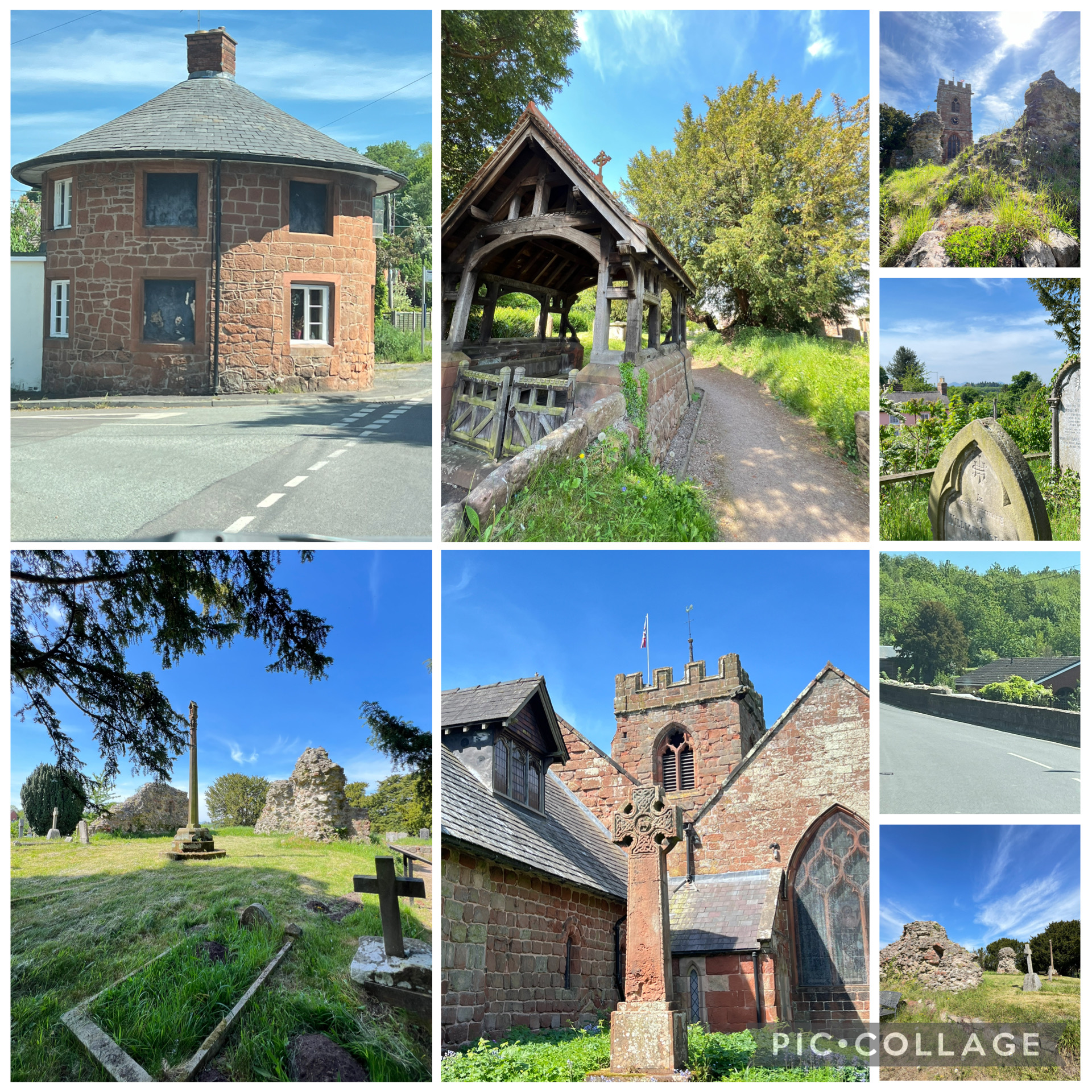
Ruyton X1 towns is an unusual collection of 11 parishes (hence the name) It contains the remnants of a medieval castle too. 

Mentioned in the Domesday Book of 1086 as Ruitone, the village acquired its unusual compound name in the twelfth century when a castle was built, and it became the major manor of eleven local townships. The earliest occurrence of the inclusion of the Roman numeral for eleven in the name is stated to be 1379

Once again, it is mentioned in the Doomsday Book. The church has a Lych Gate from 1888, erected in memory of the Vicars two sons who died within a year of each other. An ancient Yew tree stands next to it. 


The Church Tower has an impressive gargoyle on it & a plaque noting that the seats in the church are free, unreserved so an indication that all are welcome. 

How lovely it all looked against bright blue skies with wispy clouds. 

Can you see the horned devil in the bottom left? Someone had a vivid imagination. 


Heavy studded doors to the church & another set to the entrance. The stained glass windows cast their colours across the space & somehow they seemed brighter in the sunlight. 


Some views of the town & across the Shropshire hills  ... 

There are some stone remains of the castle & they frame the church well, a reminder of the long history of these towns & how they were fought over in the Marches border wars. 

St John the Baptist Parish church is fascinating with its raised bell tower platform in the church, the 12th century Norman Arches & a rather graphic medieval carving of a horned head, said to represent the Devil on an arch next to some pews.  

There is also the remnant of a 13th century stone coffin found during earlier excavations in 1892. The East window, known as the Hunt Window was painted in Munich in 1855 & it shows the children being blessed. The figures of the 2 girls were reproduced from portraits of them. Rev George Hunt commissioned them in memory of his children who died between 1831-1832. 

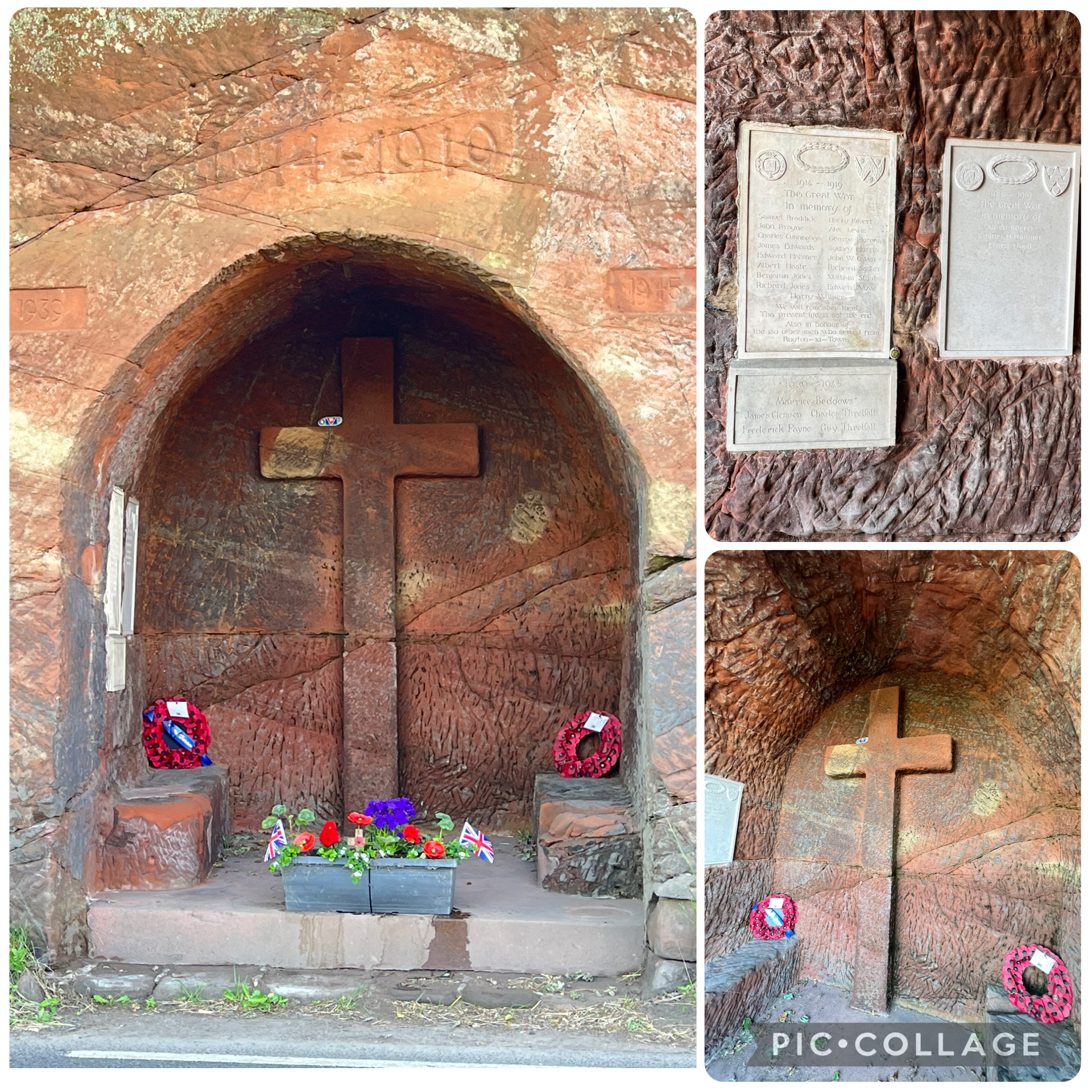
The town of Ruyton X1 has an unusual War Memorial set in stone along the road. 

The parish's WWI war memorial is an 8 ft (2.4 m) carved cave within the sandstone cliff of the Brownhill. Located beside the road leading out of the village towards Baschurch, it is unique to Shropshire. It was conceived by the London architect Stanley Vaughan after a visit to Ruyton, and created by local father-and-son stonemasons Warwick and Len Edwards. The benches within the arch and the cross are all carved out of the rock. The memorial was unveiled in October 1920. The names of fallen from both the First and Second World Wars are listed on plaques within the archway. A third plaque, to an Alfred Rogers, was added in 2007 after he had been omitted from an earlier plaque

It has the names of the towns war dead from both World Wars. 


St Martin's church of Little Ness is a red sandstone church set in tranquil countryside nearby. A service had just ended & we were given access to this modest by beautiful space by 3 church wardens who filled us in on the connection to the Darby family of Coalbrookdale / Ironbridge. 


St Martin’s was built on a mound in the 12th century as a chapel to Baschurch. It consists of a nave and chancel within one roof, with a bellcote at the west end. The circular font is Norman, as is the south doorway and there are some patterned mediaeval tiles in the chancel. There are war memorial windows to two men killed in World War I, Leonard Arthur (killed 1914), and Lieutenant Maurice Darby (killed at Battle of Neuve Chapelle 1915). The latter is buried in the churchyard, one of a few Englishmen killed at the Western Front whose bodies were repatriated.

It is a beautiful space, one that feels spiritual & welcoming, the window to Maurice Darby is a beautiful one to remember a son who died on a battlefield far from home. Opposite the window is another to an uncle. Maurice was killed & his uncle who was serving at the same time, with help, recovered his body & repatriated it. This was unusual & controversial because only 6 bodies were repatriated, the rest are all buried in exactly the same graves across Europe - no distinction given to rank at all because the ethos is they all died serving their country. The Darby graves by the door to the church are a link to local history & their contribution to the communities. 

 To the side of the church is a large ancient mound or barrow. It has been suggested it marks the resting place of the Cumbrian Prince Kyndylan who died in battle in the 6th century. However, this is only conjecture. 

We had our picnic lunch in the shade of the lane by the church with frothy white cow parsley & vivid yellow rape seed as companions.  


Our final stop was All Saint's Church, Baschurch. The church is mentioned in the Doomsday Book & in February1188 & again in March 1198. The acclaimed Engineer Thomas Telford had a hand in its restoration & it is an important example of his earlier work. 

According to an ancient Welsh poem, the church may be the resting place of Cynddylan, a 7th century prince of Powys. There is an ancient earthwork nearby called the Berth.

The church tower is c13 with 4 bells that are at least 400 years old. 


There are two 18 century sundials on the wall & are discernible in the stonework with a central hole for the peg. These would have been important when country folk did not have timepieces. 

The yew tree near the east end of the church is thought be between 500 - 800 years old & is held together with a metal band.  


I hope you have found out countryside history & pursuits interesting - we enjoyed the 1000 years of history across these ancient places.  Thank you for stopping by & spending time. 

Dee