Showing posts with label church. Show all posts

Wednesday, 1 July 2026

The Norman Parish church of Aston Eyre


While out in the Shropshire countryside on the way back from our fabulous walk at Dudmaston Hall, we passed the village church of Aston Eyre, one we had not stopped at before. 

There are no graves around the church which is quite unusual  but apparently a dispute between The Lord of the Manor, Fitz Aer & the Monks of Shrewsbury Abbey at Morville Priory resulted in all the burials taking place at Morville.   

Knowing nothing of the church, we ventured inside. 

The lovely church information brochures filled us in on the history which always makes the visits more worthwhile because you look out for the details you would otherwise miss.  It is a grade II listed building, much of it dating back to C12. 


There has been a church here for almost 900 years - let that time period sink in. The church was gifted to the villagers of Eston by the Lord of the Manor. Robert Fitz Aer in 1132. At that time, King Stephen was on the throne & there was great civil unrest in the area. 

The small church was taken over by the Benedictine Priory at Morville & used as a Chapel of Ease for the monks living there. 

It became a village church again in the time of Henry VIII who put an end to the power of the monasteries.

The Tympanum over the South Door of the Church is the best example of Norman (1066) carving in Shropshire. It depicts Christs entry in to Jerusalem. He is seen riding on an ass, to his left a bearded man with a young ass, to his right an older man spreading out palm branches. 

The South Door with its long iron hinges has the date 1636 on one of them. It is an impressive door, solid & you appreciate how many thousands of parishioners have passed through it. 

 The Nave has four Norman windows, and an impressive Transitional Chancel arch. 

It is a really peaceful space that has seen worship for almost 900 years, the sense of history is humbling. 

I am so pleased that we did this unexpected stop & could appreciate this space. 

I hope you have enjoyed the visit with me. 

Dee 🙏⛪️🔔

Saturday, 6 June 2026

A local church with interesting family memorials


We love visiting local churches, especially those with a connection to my maternal side who were Shropshire born before taking military pensions in The Cape in the mid 1850's. 

One such church is St Edith's at Eaton under Heywood. 

The church is modest, set under Wenlock Edge. In the Doomsday book of 1160, it was referred to as Tickelvorde, with the next door manor belonging to the Wenlock Priory. It is a grade 1 listed building, showing its importance. 

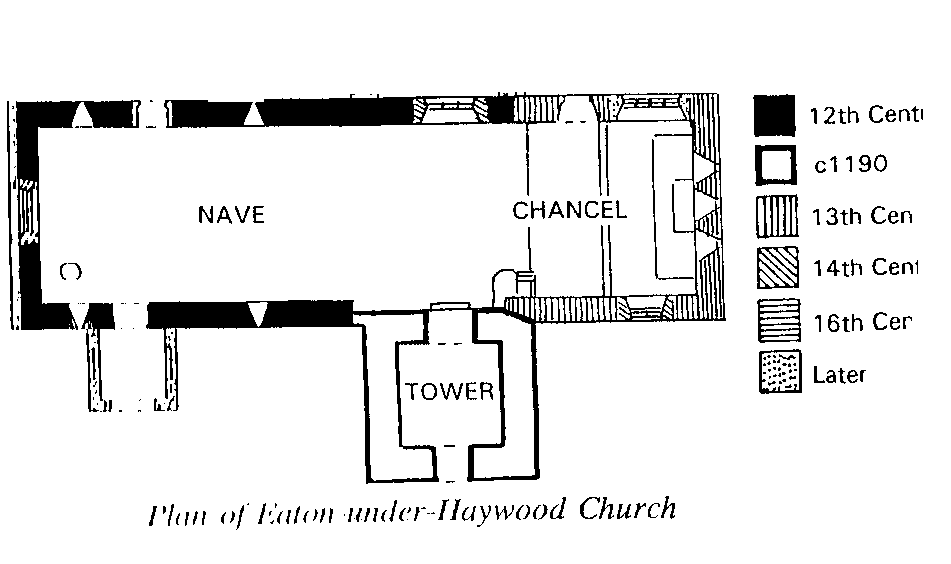
St Edith (of Wilton) - an Anglo-Saxon saint. 12th Century nave, not divided from the 13th century chancel. The tower is unusually placed on the south side, and is of about 1190. The church stands on a the hillside, and has a sloping aisle.

Eaton under Haywood church

Eaton under Heywood church is set in a tiny village surrounded by beautiful rolling hills. 


There is an effigy to St Edith who the church is named after.


The Church at Eaton-under-Heywood is dedicated to the 7th century St Edith. The church nestles under Wenlock Edge, west of the small town of Church Stretton. A small nave, which is just the western part of the present church, was built in the 12th century. The present long chancel was built c.1200; it is the same width as the nave and has three lancets in the east wall. About the same time the tower was built against the south side of the new chancel and a new north door was made in the nave.

Special features of the Church include a tub font probably Norman (cover c. 1872), a 14th-century wooden effigy in the chancel, a late medieval chest, and a superb example of a three-decker pulpit. The plate is 18th-century and later, and the three bells date from 1615, 1622, and 1869.

The church was built for the estate that the Pinches family owned for 250 years, their memorials filling the walls, leger stones in the floor & stained glass windows at the entrance. 

The estate passed to the Buddicom family, the husband of the last daughter who had no children of her own. 

Her siblings - a brother & sister had not married & so the estate passed out of the family when the last sibling wed. 

It is distant family line of my maternal grandmother & I felt strangely grounded in that space. 

I will definitely visit it again, to be able to just sit in the space & to take in the history.

I hope you have enjoyed the visit with me, 

Dee ⛪️🔔ðŸŠĶ


Wednesday, 5 November 2025

Murder before Evensong in Worfield


 A new TV production called 'Murder before Evensong'  was filmed locally in Shropshire & an unexpected free morning made us decide to head out to the village again. 

I have been watching it because I recognise so many of the locations locally like the boathouse at nearby Dudmaston Hall, the timbered buildings of Worfield, also Chillington Hall. 


I have been previously to Worfield, it is just a tiny village that retains its charm through the black & white buildings & a church that towers over it. 

An unexpected free morning saw us head out on my suggestion. We parked up to walk the street that features in the filming. It is chocolate box pretty, the houses all well maintained & it looks like a filmset. There are several listed buildings in the village.  

We had not previously visited St Peter's church because we visited on a Sunday when a service was in progress so today we took full advantage to do so. 

The church steeple towers over the church, a landmark as you drive in. The ancient yew trees in an avenue in the church yard. 

The church features in all the episodes & the first murder was committed in there in the series. 

What a fantastic space - much bigger than it appears from outside, a haven of calm (incongruous with its tv fame) .

I always light a candle & lit two today as a friend needs a prayer for her hubby in America who is ill. It is those quiet moments in churches that connect you again. This side chapel is St Nicholas - I am rather partial to that name as it was one of my late Father's names. 


I am fascinated by the history in these places - people remembered across the centuries, tombstones in the aisle floor where they are buried underneath, two magnificent memorials to the side & more. 

It has a leper window or hagioscope that is now on an inside wall - it would have been on the outside wall previously so lepers could follow the service without being a danger to others. 

The incumbent priests husband popped in & what a fascinating long chat we had. We got some history as well as an update on the filming. 

The font used in the production was a replica of the one seen, it was placed in the middle aisle where the first murder takes place. 

Spoiler alert - there is no crypt under the font!  

The font near the door was replicated & placed over this grid in the aisle, which supposedly had a crypt under it. 

The production team spent several weeks in the village & they 'might' be back.  

The village shop & pub also feature regularly & it is interesting to stroll along a 'real' film set. 

Viewing figures drive this but apparently the series has been well received to we can but hope. 

We asked about some of the memorials & were directed outside & then to the higher graves high above the church in the pretty elevated woods. 

Apparently this high area was used for the plague burials centuries ago - there is no marker as there was to the plague pits I saw at Ross-on-Wye. The reality was that most villages had plague pits & the exact location of many of them is lost in time. 

Apparently, the large yew tree by the gate is the place where infant death babies of unwed mothers were buried in times past; in the church grounds but not close to the church as social norms were at the time.


A fascinating morning enjoying our Shropshire villages & the history of them, as well as the modern influence of TV series which helps to preserve churches as the production money all helps. 

I hope you have enjoyed this morning wander with me, thank you for stopping by, 

Dee ⛪️ðŸ””ðŸ“―️🎎

Wednesday, 20 August 2025

Tracing the enigmatic footsteps of T.E. Lawrence in Dorset

 I have heard the story from my late father in law of him watching Thomas Edward Lawrence (T.E. Lawrence / Lawrence of Arabia) travel down the road past the old Dorset family home for years. He told how he used to sit on the brick front wall & watch T.E drive past & waving to him. What Johnnie didn't tell was that it was his Father TG who rode out with T.E Lawrence & that it was something they both enjoyed doing. 


Hubbies Great grandfather TG was pictured on his motor cycle with great grandma sitting side ways on the back, locally  in the lanes of Walditch. 

While in Dorset for a few days, I asked if a trip to Moreton could be on  the cards for Sunday because it is actually somewhere I had not been to even though it was not far from the county town of Dorchester that I have visited dozens of times over the years. 

That is how we came to visit Moreton, close to Bovington where T.E. Lawrence was stationed after his famous Lawrence of Arabia time when he had an ambivalent attitude to the fame that followed him. 

Grandfather TG had kept dozens of newspaper articles on him & we read them with interest. 

One said this of his attitude to fame:

He was once described as the type of man who would feign embarrassment if he walked in to a party & people recognised him - but stand on his head if no one did. 

St Nicolas Church Moreton is very special; a church has stood on that site since 1190. Its popularity is largely because of 2 persons named Lawrence / Laurence - the 13 Laurence Whistler engraved glass windows & the grave of Lawrence of Arabia, T.E Lawrence. 


The church suffered a direct bomb hit in 1940, losing the north wall & windows & being out of action for some time. 

The 12th century font remained standing amidst the rubble. 

Sir Laurence Whistler - the Father of Glass engraving - etched all 12 windows inside the church & the 13th panel - the Forgiveness Window, was the last addition. That is best viewed from outside.

The bright sunshine made the details on the windows harder to see & some were better viewed from outside. They are all very special windows.

There are impressive Minton encaustic tiles in the apse with 5 sets of 3 panel engraved windows in the circular space. 

T.E. Lawrence enrolled incognito as a private soldier - T.E. Shaw, at the nearby Bovington Camp to escape the notoriety that followed him after Arabia. 

He lived at the modest Clouds Hill house nearby so this was his local church. 

T.E Lawrence died in a motor cycle accident near Clouds Hill & his funeral was held in this church. It was attended by Winston & Clementine Churchill, G.B. Shaw & others.  T.E had served as an advisor to Churchill in the 1920's so they were well acquainted. 

Hubbies Great grandfather TG attended the funeral & there is a photo of him at the graveside. 


After visiting the church, we made our way to the grave, it is immaculately maintained because of his fame. I wonder what he would have made of the steady stream of people making the pilgrimage in his memory? 

It was very interesting walking in the history of T.E Lawrence & the shared history of great grandfather TG. I still want to visit Clouds Hill but that will be on another visit. I also need to watch the iconic Lawrence of Arabia movie with Peter O' Toole. 

I hope this has been interesting too, thank you for your company, 

Dee  ⛪️ðŸŒģðŸĄ 🚙 

Thursday, 31 July 2025

24 hours in Ross-on-Wye ...


I love history & the back stories to people & places, it puts everything in context & things make more sense. Because I was not born on these Isles but have lived here for almost 3 decades, there are gaps in my understanding of the complexities of the history that I like to fill. 

I joined hubby on a trip to Ross-on-Wye, a town we had not visited, he was there for an all day golf  competition, I was there to enjoy a new town, an opportunity to explore on my own as I don't visit the county of Herefordshire too often. 


The early morning drop off meant I could watch the town wake up from my cafÃĐ seat with a hot cup of coffee after our 2 hour trip from our county of Shropshire. 

I downloaded the visitor guide & then set off around the many streets of the little town, walking each one to the end of the town section & popping in to the many shops that caught my eye. 

This might be a bit controversial but I find vintage / antique shops to be a little lost in a town has something like 14 charity shops so vintage home wares are very evident.  I think we become selective as we get older & I prefer not to accumulate but to each their own. I seek out specific items when I need them so it is interesting to browse & to see what is in demand. 

I think my reluctance stems from clearing out aged relatives homes … 


I found the 16th century Market House to still be the centre of things, maintaining its original purpose. 

It was not a market day but people, young, old, singularly or in groups sat about on the steps or the benches, chatting, eating a sandwich, relaxing, scrolling their phones or just enjoying music from a busker in the square. 

The upstairs Made in Ross gallery had a fabulous selection of handmade wares - paintings, music, art, felt objects, wooden items etc.

It had a most fabulous view through the double doors across the square & down the street.  That spot was where announcements & proclamations would have been made in times past, from an elevated position above the crowds gathered in the square below. 

Opposite was an imposing black & white building that had belonged to John Kyrle (1637 - 1724) known as The Man of Ross. He is celebrated all over town, including a memorial in St Mary's church & on a pub at the end of the High Street that is named after him. 


Late afternoon, I took my iced drink to Prospect Park, situated next to the church, that John Kyrle had given to the towns folk for leisure. 

It had a public drinking fountain at one time, essential in times past when water was not on tap. 

He never married but his philanthropic influence was immense. 

The park is still well used & I enjoyed the coolness under the trees, relaxing & watching some squirrels inquisitively trying to catch my eye in case I had something to eat in my bag. 

It was the perfect spot for some reading,  having my snack I bought at the nearby deli & taking time to enjoy the green space, as its original purpose was. 


Churches are a font of local knowledge & this one was no different, set with elaborate memorials & impressive windows. St Mary's church has been the cornerstone of the town for centuries. The Gothic Markye Chapel, set to the side contains the war memorials & it is always humbling to see how many men in each town gave their life in service to their country in the wars that span time. 

 Alms Houses  were established in England from the 10th century to provide shelter & care for the impoverished in the community, often widows left destitute & in need of support.  

These neat row of houses just down from the church date to 1575. I have seen similar ones in towns in Shropshire, they hark from a time when that was really the only safety net people had centuries ago, that & the work house. 


The church had a notice board charting the history of one family & their connection to the slave trade in Jamaica in times past. A reminder that history is found in every corner of a town. 


The notice board at the church doors gave mention of a Plague Cross & pit in the grounds & I set off to see it. 

The cross commemorates 315 souls who died in the great plague of 1637. They were hastily buried each night without coffins in pits just to the side of the cross. 

The Revd Philip Price officiated at the mass burials each night, a Christian act in the times of crisis.  

The reality of life in times past very evident, life was so fragile, death was never far in those times & mortality was high.  

A reminder of our recent epidemic & how it effected life so quickly. The more things change, the more they stay the same ... 


The close around the church has the Royal Hotel, on the site of the Bishop's Palace that was home to the Bishop of Hereford in times past. 

The original timber structure dated to the 12th century. Opposite is stone walls on a raised position. However, the tower & wall dates to 1833 when the new road was built & the mock gothic town walls & tower were constructed.  They are now almost 200 years old  & part of the landscape, as if they had always been there. 

We had a drink on the pub terrace later in the evening, enjoying its elevated position over the River Wye & the surrounding countryside. 

On the end of the High Street behind this, was a The Old Court House with glass covering the original stone window with bars on it. Just opposite was a note on the old Swan and Falcon Inn to note that Horatio Nelson visited it in 1802. 

The information blue plaques & notice boards set about town & on buildings really brought the history to life so you can visualise & appreciate the long passage of time in the town. 

Because I was to be in town the whole day, I chose a central hotel, The Kings Head, a traditional coaching inn. We used to stay at a similar one in Stokenchurch, Buckinghampshire  & I love the quirkiness of these old places. 

This one did not disappoint with its odd spaces, creaky staircase, uneven floors & dark wooden beams.   Our room was on to the High Street & cars rumbled past before it quietened down late evening. 

You could hear people moving about as the floors creaked & settled down for the night. It is sobering to think that people have stayed in this coaching inn for about 700 years. 

Breakfast was downstairs & I glanced down & saw a lit glass panel above a stone well set in the floor. 

The landlady said the well is about 50 feet deep, not used now but it was essential in times past. This really brings the past in to focus & the age of the building is evident in these things. 

I had a very interesting 24 hours in Ross-on-Wye, I am so glad I seized the moment to have a change of scenery. 

I hope you have enjoyed the account too, 

Dee  ðŸš™ 🏘⛪️ ☕️

Monday, 12 May 2025

An original ducking stool ...

I know I shared this in the previous post  on the Welsh Marches / Shropshire churches but I feel it deserves its own story. 

St Peter's Church in the pretty village of Myddle just oozes old charm - the tiled floor, the black roof beams in a lovely pattern, the font in the bell tower, the list of Rectors stretching back almost a 1000 years, it all speaks of being the centre of a community, of history & continuity. 

However, I did not initially take in the importance of the wooden chair up high on the wall, out of reach above a cabinet. 

At first, I did not recognise it as such, but while reading the 'Short history of the church' booklet on the way back to the car, I realised what it was - a ducking stool. I had never seen an original one which is why I did not register what it was. 

I just had to return to do a better photo & to take in the history of it because I was quite shocked to see it in St. Peter's Church in Myddle. 

Myddle is one of the ancient Shropshire villages named in the 1086 Doomsday book, a type of early census which took account of people, livestock etc. 

Some early history of the village of Myddle 

The village of Myddle was occupied by 1066, with a manor house for Siward, Earl of Northumbria completed in the 1050s.[3]

By 1086, the year of the Domesday Book under William the Conqueror, the manor house was occupied by Rainald the Sheriff. During the 12th century, the Fitz Alan family of Clun occupied the manor house, with John Le Strange acquiring it around 1165.

In 1234, Myddle was the location of the signing of a treaty between King Henry III and Welsh Prince Llewellyn.

In September 2005 and September 2007 a detectorist uncovered a small number of hammered gold coins dating back to the 14th century.

The Le Strange's dynasty ended in 1580 due to the lack of male heirs to the estate, and Myddle passed to the Thomas Stanley, 1st Earl of Derby after he married Joan Le Strange. Their son, Thomas, became the second Earl of Derby.

Elizabeth I granted Thomas Barnston a licence to sell land in Myddle in 1596, and in 1600 Sir Thomas Egerton purchased the village. Egerton's son was created by James I the first Earl of Bridgewater in 1617.

During the English Civil War in 1642, Charles I recruited 20 men from Myddle, with 13 killed

Myddle suffered an earthquake in 1688, but continued to expand throughout the coming centuries, with butchers' shops, taverns, fishmongers and masons inhabiting the village by about 1850.

With such a long history, there will be outdated practices but ones which were in keeping with the times. 

Ducking stools were medieval chairs used to publicly punish,  humiliate & censure women for offences such as scolding, sexual offences such as illegitimate children, backbiting, prostitution & more. 

They were enforcement of social norms through public humiliation. Some were humiliated after mass through the public reading of their 'sins'

The construction of the chairs were usually of local manufacture with no standard design. Most were simply chairs into which the offender could be tied and exposed at her door or the site of her offence. Some were on wheels like a tumbrel that could be dragged around the parish. Some were put on poles so that they could be plunged into water, hence "ducking" stool. Stocks or pillories were similarly used for the punishment of men or women by humiliation.

The number of duckings was determined by the magistrate who presided over the sentence.   

Usually, the chair was fastened to a long wooden beam fixed as a seesaw on the edge of a pond or river. Sometimes, however, the ducking-stool was not a fixture but was mounted on a pair of wooden wheels so that it could be wheeled through the streets, and at the river-edge was hung by a chain from the end of a beam. In sentencing a woman the magistrates ordered the number of duckings she should have. Yet another type of ducking-stool was called a tumbrel. It was a chair on two wheels with two long shafts fixed to the axles. This was pushed into the pond and then the shafts released, thus tipping the chair up backwards. Sometimes the punishment proved fatal and the subject died.

These were grim times for women who had no rights of their own, they were at the mercy of the men around them. Look at the images on wiki to see how the chairs worked. 

The use of ducking stools during witch trials which gripped England in ancient times is better known. They would be tied to the chair or hand to foot & plunged in to water. If they floated, they were guilty (in league with the devil) if they sank (drowned) they were innocent; so either way they died. 

These were grim times indeed & being so close to one in a church was really sobering. I knew of the dark history of the chairs, especially during the witch trials, so it was, for me, a moment to reflect on how far we have come to entrench women's rights. 

An ancient object which symbolises so much. I hope you have found this account interesting too, thank you for stopping by, reading  & leaving a comment too.  

Dee