Friday, 19 June 2026

The Knife Angel statue returns to our county town of Shrewsbury


The Knife Angel returned to Shrewsbury from its travels around the UK & was installed in the Square where I popped past to view it today.  

It had been on display some years ago but a return visit is worthwhile. 

We visited the British Ironwork Centre last year & saw the Knife Iron between its visits to major centres around the UK.  

All of the ironwork statues are so impressive, pop past this blog post to see them


The Knife Angel was made from 100 000 handed in or seized knives & blades from police forces across the UK. 

It stands 27 feet tall, its hands outstretched in from of it, the coloured blades glistening across the whole statue. 

The angel wings are a juxtaposition to the glint of the blades. The expression on the face is 'WHY'

The making of the Knife Angel is set out on the website of the British Ironwork Centre where the artist Alfie Bradley explains the process of procuring the knives & the expression he wanted for the angel. 

It is a powerful anti knife message & all the cities it visits, pledge to use it to educate on the effects of knife crime. 


It is a national statue that did not receive any public funding. 

The Knife Angel serves as a memorial to those killed by knife crime & as a remembrance to their loved ones. 

I am privileged to have seen it three times, in two different towns & where it was made.  

It is a powerful statue with a sobering message & when I stopped past this morning, there were many people stopping by it to read the information & to photograph it against the traditional square. 

Thank you for stopping by, it is appreciated. 

Dee 

Tuesday, 16 June 2026

The charming church of Clee St Margaret with an long history ...


My regulars know how much we love the history of our many countryside churches, each so different, many Shropshire ones connected to my ancestry. 

We stopped by Clee St Margaret, a village on the high slopes of Brown Clee Hill in Shropshire. 

From the road it looked unremarkable but as soon as you approach, the history stands out. 

The chancel walls facing the path have the herringbone masonry patterns associated with ancient buildings. 

It is very distinctive on two sides, showing this part is the oldest of the church. 


The beautiful church information booklet mentions it is recorded in the Doomsday Book of 1086 which was a type of census recording of towns, villages, villagers, livestock etc. 

The earliest known reference to a church at Clee St Margaret was the taxation records of 1291. 

There was likely a church here from Saxon times even though no trace is visible today. 


The Chancel with its herringbone masonry could be Saxon, but the small chancel arch is Norman, with pillars that support the pointed arch. A Saxon arch would be rounded, hence the Norman dating. 


There are so many features that are considered with the dating of churches & I admit to having only a scant knowledge of them, not enough to pin point the dates. However, it is a learning process & each visit brings something else to be aware of which is useful.

The war memorial tablet is in the window - the details of the fallen of the parish are here 

The wooden South door is about 600 years old, probably Norman too. The roof of the chancel & nave has timbers dating to the 14th & 15th century, probably local timbers from the Brown Clee forests. It is a listed building 

The pulpit & chancel doors are Jacobean (1603-1625) . The carved wooden chancel doors are unique, giving the chancel area a secular feel, away from the main church. The thick walls of the chancel have an interesting shape. 


We were both taken by the serene atmosphere in this unexpectedly spiritual space. Sometimes churches that are stripped back without too many adornments hold a special space & feeling. 

We lingered here, taking in the quietness & the feeling of history, of peace and of being somewhere special. 

The church had various Victorian 'restorations' done in 1872 - 1897 but it has not distracted from this beautiful space. 

Sometimes, we find ourselves in unexpected spaces. Thank you for stopping by. It is always appreciated. 

Dee ⛪️ðŸŠĶ🙏🔔

Saturday, 6 June 2026

A local church with interesting family memorials


We love visiting local churches, especially those with a connection to my maternal side who were Shropshire born before taking military pensions in The Cape in the mid 1850's. 

One such church is St Edith's at Eaton under Heywood

The church is modest, set under Wenlock Edge. In the Doomsday book of 1160, it was referred to as Tickelvorde, with the next door manor belonging to the Wenlock Priory. It is a grade 1 listed building, showing its importance. 

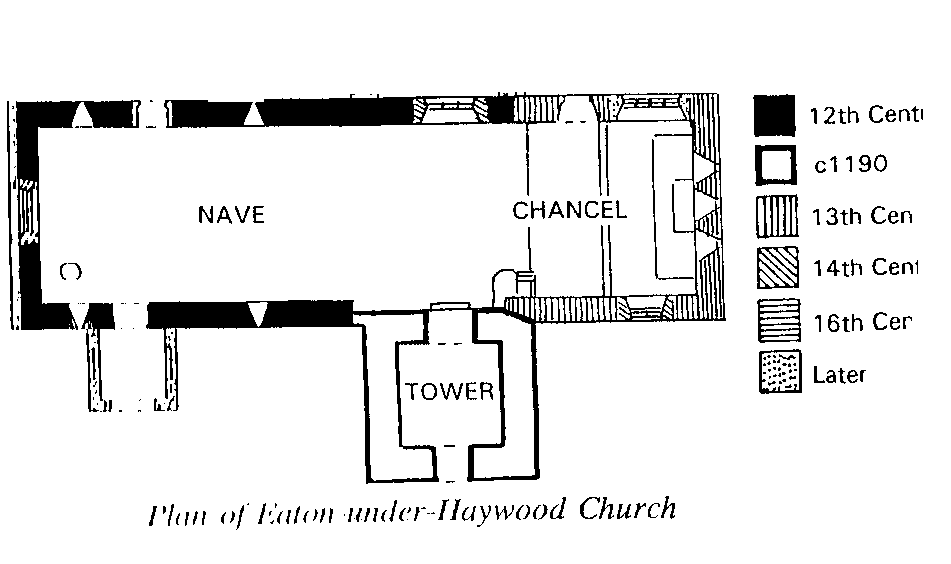
St Edith (of Wilton) - an Anglo-Saxon saint. 12th Century nave, not divided from the 13th century chancel. The tower is unusually placed on the south side, and is of about 1190. The church stands on a the hillside, and has a sloping aisle.

Eaton under Haywood church

Eaton under Heywood church is set in a tiny village surrounded by beautiful rolling hills. 


There is an effigy to St Edith who the church is named after.


The Church at Eaton-under-Heywood is dedicated to the 7th century St Edith. The church nestles under Wenlock Edge, west of the small town of Church Stretton. A small nave, which is just the western part of the present church, was built in the 12th century. The present long chancel was built c.1200; it is the same width as the nave and has three lancets in the east wall. About the same time the tower was built against the south side of the new chancel and a new north door was made in the nave.

Special features of the Church include a tub font probably Norman (cover c. 1872), a 14th-century wooden effigy in the chancel, a late medieval chest, and a superb example of a three-decker pulpit. The plate is 18th-century and later, and the three bells date from 1615, 1622, and 1869.

The church was built for the estate that the Pinches family owned for 250 years, their memorials filling the walls, leger stones in the floor & stained glass windows at the entrance. 

The estate passed to the Buddicom family, the husband of the last daughter who had no children of her own. 

Her siblings - a brother & sister had not married & so the estate passed out of the family when the last sibling wed. 

It is distant family line of my maternal grandmother & I felt strangely grounded in that space. 

I will definitely visit it again, to be able to just sit in the space & to take in the history.

I hope you have enjoyed the visit with me, 

Dee ⛪️🔔ðŸŠĶ


Tuesday, 26 May 2026

Unwelcome garden visitors ...


The Dorset in-laws propagated some box plants for us some 25 years ago from cuttings on their bushes on the family plot. 

They were about the size of a small football when they came to our garden & I have tended them ever since. They have moved thrice with us & went in to the ground at our home some 8 years ago. 

It is very therapeutic to clip them gently in to their large round shapes several times over summer & to enjoy their structural shapes over winter when the snow rests on them like large Christmas puddings. 

I was sitting on the patio reading today when movement caught my eye. On closer inspection I saw it was the dreaded box hedge caterpillar, several of them on the box closest to me. 


These vile creatures can decimate a healthy plant in no time as they munch their way through the  bush &  their lifecycle continues with eggs being laid & another huge clutch of them appearing to continue on the bush. 

I immediately made up a solution of white vinegar & dishwasher soap in a spray bottle & sprayed it all over the bushes where the leaves were looking depleted. I spied caterpillars on all the bushes  & the far one has extensive damage to the one side. 

I thought that my mixture of soap & vinegar might delay them while I researched some treatments. 

Another resident in our community had reported box caterpillars recently & our local garden nursery said they had a spray for it. 

We duly went down & bought 2 large spray bottles of it as it will need more than one treatment to break the lifecycle. 

Can the 25 year old box balls be saved? I don't know because this is going to be a battle of the wills to stop them. It will need consistent treatments & they might be back again. 

Has anyone got any advice in dealing with this? Thank you for stopping by, 

Dee 🊏ðŸŠīðŸĄðŸ›ðŸ›ðŸ›

Sunday, 24 May 2026

Every garden needs some honesty ...


Every garden needs some honesty - the lunaria type of honesty with its beautiful purple flowers that become green pods with a pointy top & with the seeds visible. 

They become stunning translucent papery pods that dry out & keep for months in a vase. 

I love the hint of the seeds in the green pods as they grow, then the pods dry on the plant with dark papery skins that rub away easily to reveal the seeds & the gorgeous iridescent seed pods. 

Mine self seeds in various places on the patio & the pods are forming their beautiful green shapes. It looks like the stems will have loads of pods this year.

I look forward to picking the stems in the autumn when they have set seed, then popping the stems in a vase on a windowsill so their beautiful pods catch the light. 

This is a large vase in the kitchen window with the pods from last year. Aren't they just gorgeous? 

I hope you grow some too as they are low maintenance. Pop by again soon, 

Dee 

Saturday, 23 May 2026

Sowing some summer salads


Some years ago I bought 3 raised planters with plastic covers to grow my summer salad leaves in. Covered planters give confidence that the leaves are organic & protected from sharing it with birds, the squirrels or even snails. 

Today I scooped out about half of the compost in the planters, added in new compost & some perlite to keep the soil loose. 

I sowed several kinds of rocket leaves, some lettuce as well as some nasturtium seeds that are a favourite as the peppery leaves are good in a salad & the pretty flowers brighten a summer salad & they are edible. 

One of the planters still has a very healthy sage plant, a large celery & some spring onions. They will stay for now. 

It is a joy to pick salad leaves for salads that I eat daily in summer. It takes little effort once they get going. 

The annual tomato planting challenge was completed too. Hubby was gifted 4 plants & I bought another 2 & they were planted in a tomato grow bag. This is always next to the conservatory side where it is warm but sheltered so they tend to enjoy that spot. 

It is a hit & miss activity because the tomatoes do not always do well & sometimes we have had only a few for the effort but it is an annual activity. Who else pits their skills against tomatoes each year? 

Thank you for stopping by, 

Dee ðŸ‘Đ‍ðŸŒū🍅ðŸĨ—ðŸŦœðŸŠðŸĄ 

A leisurely canal lunch

 A few years ago I treated my friend to an afternoon birthday tea on the local canals.

I decided to do a canal trip lunch &  ream scone tea treat with cousin Lorraine so we could catch up at leisure efore she prepares to go home to South Africa after her extended stay. 

The local canal cruise is a leisurely & smooth trip along the Shropshire Union Canal. 

The hot fish & chips was served as we set off & we could enjoy it while watching the canal-life. We opted for the mini portion so we could enjoy the tea & scone too.

Pots of steaming tea, coffee & other drinks were offered & enjoyed. The 3 staff / crew work hard, serving, popping on & off to do the locks & one doing the steering. 

It is a great way to enjoy a few leisurely hours over lunch. 

Who else loves canal life? Thank you for stopping by, it is appreciated, 

Dee ⛴ðŸšĪðŸ›ģ🐠🐟


Tuesday, 12 May 2026

George, an Ambassador for art


Cousin Lorraine & I set off on another adventure, taking in local places of interest while she is still visiting from South Africa. 

I have not been to the  National Trust Dudmaston Hall in at least a decade, even though it is not far away from the Shropshire town of Bridgnorth that I pop in to quite often. 

I shall remedy that again soon as it came on to drizzle so we did not walk around the lake or generous estate gardens. 

The house still has private sections occupied by the family but it is a lovely bright space with gorgeous views over the lakes, gardens & trees. It has the most enormous grandfather clock downstairs - I do not even come up to the face dial ... 


On arrival, we were told that an art tour of the house was starting in a few minutes if we were interested so we took our token & headed to the house. Just 7 of us & a very knowledgeable guide who took us through some of the history of the owner & his magnificent but eclectic collection of art. 

Sir George Labouchere was an Ambassador to several countries. 

He indulged his passion for art by collecting art from known artists as well as new ones that he was interested in. 

His wife, Rachel Hamilton-Russell, inherited the family estate of Dudmaston Hall but she accompanied him, & they both eventually retired to this Shropshire gem


She was an accomplished artist who trained under John Nash at Flatford Mill in Suffolk - painting travel brochure like images of the countries where they had been stationed in & these are on the stairwell. 

Some of her botanical work is also on display but somehow we missed that section so a return visit is needed. 

Few private collections can boast of a Kandinski, even if it is a modest one, not in the bright colours usually associated with him. The collection also features 'Head of a girl' by Henri Matisse 


Work by the local painter & sculpture Anthony Twentyman (1906-1988)  was on loan from the Wolverhampton Art Gallery.  

Twentyman's work is on display, as well as several larger pieces in the gardens. 

The gardens contain some sculptures that Sir George commissioned from Twentyman, including 'The Watcher' which is a large sculpture in the gardens. 

The maquette is on display in the exhibition facing the gardens where the full size is. 


I was interested in the Spanish Civil War exhibition because Ms M & I had done a tour a few years back because her Mother Marjorie had served as a volunteer nurse in the Spanish Civil War.  I blogged that experience of our trip that you might like to read.

Sir George had served as an Ambassador while Franco was in power & he collected works by lesser known artists that Sir George considered to be interesting, in a time when the country was ruled with a tight fist. 

The exhibition invites us to consider this: 

Rebellion and Repression

Sir George and Lady Labouchere were in Spain during the dictatorship of General Franco. They were dark and difficult days and many used art to express their emotions. Despite the anti-establishment message of the works Sir George collected, he maintained good ambassadorial terms with the General.

'El Cine' by Antonio Saura is an example of anti-establishment art by Saura who spent many years in exile from Franco’s regime. It gives the impression of a crowd looking at a huge screen. The screen contains establishment figures, but who is watching who?

Modern Movement

Barbara Hepworth, Henry Moore and Ben Nicholson were three of the most influential British modern artists of the 20th century. They were key figures in the development of British Modernism, experimenting with new materials and techniques to challenge the traditional idea that art needs to depict the world it represents realistically.


The Henry Moore 'Seated figure against a curved wall' maquette was number 10 & it is the one the final sculpture was based on. The full size sculpture is at the UNESCO headquarters in Paris 

The Modern Art collection includes impressive works by Henry Moore, Barbara Hepworth & Ben Nicholson, household names that command attention. 

A very interesting collection, collected with 'the same eye', a mans passion for art, culture, history. I love taking guided tours because of the information & knowledge that you gain so it is so much more meaningful. 

Thank heavens we can view this collection locally. I will certainly be returning again soon to take in the vast gardens, the lake & boathouse which were used as a film location recently for the TV series - Murder before Evensong. 

We could catch our breath & enjoy a lovely light lunch at the beautiful on site cafÃĐ before reluctantly going our way again. 

I hope you have enjoyed the visit with me, do stop again soon, 

Dee ⛲️ðŸŒģðŸŠūðŸŽĻ🖌️🖞️

Sunday, 10 May 2026

The joy of homegrown rhubarb


My parents & grandparents grew rhubarb & I have always loved the sharp taste, especially when tempered with a sweet custard or a dollop of cream.  My late father in law always 'forced rhubarb' for a treat at Easter by putting a vintage chimney pot over the crown with hay on top to force it in to early growth. It was a delight with hot custard. 

Our own crown is grown in a rather large black pot in the garden & over the winter, I added some of the wood ash from our log burner to the pot, apparently it is something they really like. Truth be told, the wood ash was emptied on a different part of the garden over the winter to spread it out because ash is beneficial to plants in moderate amounts. 

Our rhubarb has certainly put on a growth spurt & I decided to pick some today for a Sunday pudding. The leaves are toxic so they were cut off. The stalks were washed well, cut them in to shorter lengths, layered them in to an oven dish. I added about 150g of frozen cranberries to the rhubarb, sprinkled a generous lot of brown sugar on top & mixed the cranberries & rhubarb to mix them up. 

All it needed is a crumble topping. Here is a healthier topping , or this one I used previously with more precise measurements. I usually wing mine - about 4 large serving spoons of flour, just less in rolled oats, 1 large sprinkle of desiccated coconut, a sprinkle of brown sugar & about 130g of butter. All were worked in to a large crumbly mixture, & then sprinkled generously over the fruit. 

Baked at about 180 fan for 30 minutes, but covered in foil after about 15 min to stop the top browning before the fruit had cooked. 

Served hot with a dollop of honey yoghurt. Absolutely scrumptious. 

I hope you have something growing that you also enjoy. Thanks for stopping by, 

Dee 🊏ðŸŠīðŸ‘Đ‍ðŸŒūðŸĄ


A creative week at Making Zen


I am naturally a creative person who loves the quiet time of making things that do not have to have a purpose at all, other than to bring joy to the maker.  

I took art at tertiary level & always found the drawing side to be more challenging than the making side. 

My Mother & Grandmother could turn their hands to most sewing projects & I am comfortable with 'just having a go'.

I love to join the online 'Making Zen' retreat run twice a year usually because it exposes me to new skills that I might use in a different project but the skills are never lost. 

These are some of last years projects from the Making Zen retreat -  

Sewing a pouch with a gusset 

Weaving with intention 

Making a tsunobukuro style bag

and some previous ones 

Using new stitches to make a baobab tree 

Using water soluble film to make a new fabric 

Stitching some little zen bags 

I do not subscribe to the (bought) VIP package, but print off the workshops & handouts & make notes along the way to help me remember the techniques further down the line. Each unpaid one is only available for 24 hours which galvanises the mind to concentrate on the techniques. The ethos of reusing fabrics is a great one across all the workshops & the tutors all encouraged it. 


Meredith Woolnought, who did the reverse applique technique I used previously, had an interesting workshop on negative spaces. It was a paper activity that has many practical uses. It is not something we think of too often, the spaces between that define an image. Her workshop used a background circle & then torn or cut paper to create an evenly spaced work. I had a travel brochure at hand & decided to use that while she was demonstrating. 

I did a second one with another 2 pages from the travel brochure but was drawn to the words on the article so I cut them out & it then became like a journal entry - a very interesting concept that can be applied to journaling I think. 

The Stitchers pocket companion pouch by Giovanna Zara was not as straightforward as the tutors expert work, but I used fabrics 

I already had & it was passable. Short cuts seldom work & the machine stitched sides kept bunching up in the bobbin & I had to then oversew with blanket stitch anyhow.

 I should have just done the hand sewing instead of using the machine. You live & learn. 

Many of us were looking forward to the workshop by Claire Voelkel-Sedlmeir where she made wishing houses to hold intentions. 

I told you these workshops are totally self indulgent & zen at the same time. 

It uses a 4x8 inch scrap of cloth that is embroidered, stitched & then folded over. 

I had a piece of vintage lace out so used that for the roof part then got totally carried away with the stitching on the front, a cottage covered in rose blooms. 

It was a fun one to make & her lettering advice was very helpful indeed; I find my lettering is not as neat as it should be but that is simply a lack of practice.

I am always extremely grateful to the inspirational & diverse workshops offered & the new skills I learn. 

I hope I am not the only one who believes in life-long learning & honing in of skills. 

Thank you for stopping by, it is greatly appreciated

Dee ðŸ ðŸŠĄðŸ§ĩ📍🔖📝