Showing posts sorted by relevance for query warsaw. Sort by date Show all posts

Friday, 3 August 2018

Remembering Warsaw, 74 years later

Hi everyone,

I shared some of my recent travels across Scandinavia & The Baltics but I just have to pay homage to Warsaw 74 years after the uprising in the Ghetto that snippets are known of worldwide.

Stacy & I visited Warsaw & we were both really taken by the City, one of our favourite places.

The UK tabloid The Daily Mail covered the remembrance events this week with this article 

Warsaw traffic stopped for a minute's remembrance as the sirens sounded at 5pm, the exact hour when the August 1 revolt started 74 years ago.


This beautiful corner of Warsaw saw so much sadness & heroism ...


Seventy years ago this week, German authorities liquidated the Warsaw ghetto, a 1.3-square mile area sealed off from the rest of the city where authorities forced all of the city’s Jewish residents to live. At its peak, more than 400,000 Jews were crammed into the ghetto, living in squalid conditions with insufficient food rations. No more than 20,000 of them survived the Holocaust. 

Returning to the Haunted Ground of the Warsaw Ghetto

The 1946 memorial tablet at the memorial ground


The first part of the monument, a small memorial tablet, was unveiled on April 16, 1946; the plaque was in a shape of a circle, with a palm leaf, a Hebrew letter "B" ב, and a Hebrew, Polish and Yiddish inscription: "For those who fell in an unprecedented and heroic struggle for the dignity and freedom of the Jewish people, for a free Poland, and for the liberation of mankind. Polish Jews”. It was also decided to build a larger monument in the future. reference 


Warsaw Ghetto Heroes monument


The memorial is located in the area which was formerly a part of the Warsaw Ghetto, at the spot where the first armed clash of the uprising took place. This is the western face of the memorial. 


The monument stands 11 meters (36 ft) tall. As Rapoport himself explained, the "wall" of the monument was designed to evoke not just the Ghetto walls, but also the Western Wall (Kotel) in Jerusalem. The great stones would thus have "framed the memory of events in Warsaw in the iconographic figure of Judaism's holiest site".[4]The western part of the monument shows a bronze group sculpture of insurgents - men, women and children


The Eastern side of the memorial ...


The residents of the Ghetto in Warsaw were sent to Treblinko & we all know the dark history of those camps.

When I visited Riga in Latvia, we visited the remains of the Great Choral Synagogue which was close to our hotel - read about it here . Visiting that part of Poland / Germany / The Baltics was to bear witness to the dark history of WW11 - I felt the weight of history very keenly there, you cannot escape the sadness, the cruelty, the history of it & I hope that everyone has the opportunity to walk in the path of history so that we can understand how easy it is to turn a blind eye or be too accepting of what we are told.


So amongst these beautiful cities, seek out their history & be humbled by it ...


Thank you for stopping by, for supporting my blog & being kind enough to leave a comment
Dee ~💕~

Sunday, 15 July 2018

Make time for travel ...

Hi everyone,

I apologise for my rather long absence but a rather impulsive travel plan got in the way of things.

Youngest daughter is home between finishing university & beginning her graduate scheme up north & I have enjoyed the rare opportunity of having her back in the nest. She accompanied us to visit my Dad in February & March this year in South Africa.

In May, while out for supper, we were talking about DNA & heritage - my largest DNA is Scandinavian which is a nod to all those fabulous explorers from Germany, Holland, Poland, France, Norway & Denmark who keep appearing in my tree prior to them setting off for Southern Africa in the mid 1600’s.

We found 2 remaining places on a Scandinavian & Baltics tour & I decided to seize the moment & take time away from a difficult term (I am self employed so can be flexible)

With barely 2 weeks to get ready, we set off on our 16 day tour which was almost like tracing my ancestry & it made me thankful that we live close to so many of these countries (in that they are not on the other side of the world.)


Belgium is lovely - perhaps because I speak Afrikaans so Flemish is understandable & it just feels comfortable.


From Brussels, we headed to the lovely German capital, Berlin. I want to return to Berlin for a few days, our time was too short but it is such a stunning city with such an interesting (and dark) history that deserves more time to just take it all in.

It was a real highlight to stand at the Brandenburg Gate - the site of so many monumental changes & it is such an iconic & imposing structure.

The remains of the Berlin Wall is a sad reminder of recent history - I remember the fall of it & the jubilant scenes. To stand at the remaining part by Checkpoint Charlie and to see the sign indicating where Hitler had his bunker is very sobering - history is brutal & we need to learn it to stop us repeating past mistakes.

However, Berlin has so many exciting new buildings that herald in daring architecture & the future that I know I will return to explore more again.


The Mohne Dam is yet another powerful reminder of the war between our countries - it is better known as the Dambusters dam 


The Möhne dam

Situated at Gunne and 25 miles east of Dortmund, construction of the dam was started in 1909 and finished in 1913. The wall was made of limestone rubble masonry and was protected against seepage by a clay bank to about one third of the water side face and with overflow outlets near the top. This construction stood 112 feet high and had a base thickness of 130 feet tapering to 25 feet at the top and is 2100 feet long. The dam holds back 135 million cubic metres of water, covering an area of 3229 acres. It was protected before the raid by 2 anti torpedo nets in the water and anti aircraft guns of 20 and 37mm calibre mounted on the shore and on each of the two towers.
After the raid over 2,000 workers took just 4 months to rebuild the wall ready for refilling. The power station at the base of the dam was washed away along with most of its foundations and was never re-built.
Then we crossed from Germany to Poland as my great grandfathers family had done. I looked at the passing villages & thought of the route I was taking was a route they had known  - very strange feeling that somehow connected the generations. 

Because we had booked at short notice, taking the last 2 places on the tour, neither of us had researched any of the places we would be visiting & we arrived in Warsaw without any expectations of the city - how wrong we were. What a fascinating & fabulous place it was - a definite favourite with both of us. 

I loved how they celebrated Chopin with a very large statue in the park where open air concerts are held in Summer. Dotted about Warsaw were also 14 benches, placed in places of importance to his life. These benches each played a different piece of music & told the story of that connection. 


 The Royal Palace gardens were quite a treat - influenced by the British layout of Royal gardens with fabulous Palaces & spaces.


You cannot escape the dark past & recent history of Germany & Poland & in Warsaw, the Warsaw Ghetto site is a powerful reminder of the transportation & annihilation of the Jewish population. Anyone who stands on the site of the Warsaw Ghetto will feel the weight of history & know that they have a responsibility to keep that history sacred.


However, the City of Warsaw is much older than just that period of history, it is a proud city which had to rebuild itself after it was almost destroyed in WW11. The rebuild was a made to reflect the original & it is hard to know what was original & what was rebuilt.  It is just a fabulous place to explore. We loved the many cobbled streets with the churches, castle walls, little squares, fantastic architecture & just felt so at home there.


Stunning architecture & history, a truly beautiful city. 


Lots of contrasting building & a lot of cranes on the skyline as the city expands. They had a very impressive tram system that crisscrossed the city & took workers up & down to cut down on traffic.


We always try to find somewhere authentic to eat when we travel - what better than to take advantage of a lovely street cafe opposite a lovely church. While eating a tourist horse & carriage came past - it was a relaxing time to people watch & to enjoy the atmosphere of this lovely city.


How beautiful is this Palace with its stunning architecture, I love the towers & their copper / green domes which dot the skyline.


This square is simply stunning & the heart of the city; the gorgeous buildings just frame this space perfectly & the side streets were just as stunning, a truly beautiful city.


Our view while we ate our lunch ...


You could not visit Warsaw without paying homage to a truly inspirational lady - Maria Curie - Polonium was her discovery & named after her native Poland. My daughter is a Physicist & she was so thrilled to see this statue .... 


Just near our hotel, I came across a familiar logo - that of our British Annie Sloan. I use her chalk paints so often for projects & have done her courses so I had to pop in & say ‘hi’ & find out about her shop. 


I hope you have enjoyed these images, more to follow. If you ever get an opportunity to visit Poland, seize it because it is simply stunning. Thank you for stopping by, please leave a comment or even just a ‘hi’ so I know you have visited. 

Dee ~💕~

Sunday, 26 January 2025

#1 Following in Anne Frank's holocaust journey ...

World War 2 with its far reach across Europe & how it effected even my family right down on the Southern tip of Africa reminds me how interconnected we are. 

I first heard of Anne Frank & her diaries when I was studying German in high school & a neighbour lent me an LP box set of records detailing her diary. It was in German & I found it hard going but my maternal grandfather spoke German as one of his home languages - his Father had been born in Germany, now Poland, and his Mother was Dutch.  So we sat together on a weekend after Sunday lunch & we would listen together & grandpa would then give me the gist of the matter as he understood German better than I did. He had served in WW2 as part of the massive South African effort & it was a time frame that brought tears to his eyes, the conflicts of culture, of his heritage. 

I had previously visited some Holocaust sites in Riga & in Warsaw  & the Shoes along the Danube in a Budapest 


I decided to join an Anne Frank & Oskar Schindler specialist tour before Covid postponed it for 3 years.  That part of Europe is ingrained in my DNA & I do not understand the deep connection. I travelled as a single but knowing one of the other ladies from a previous trip.  There were several single travellers because it is not a tour everyone feels the need to do, but those who do, have their reasons.

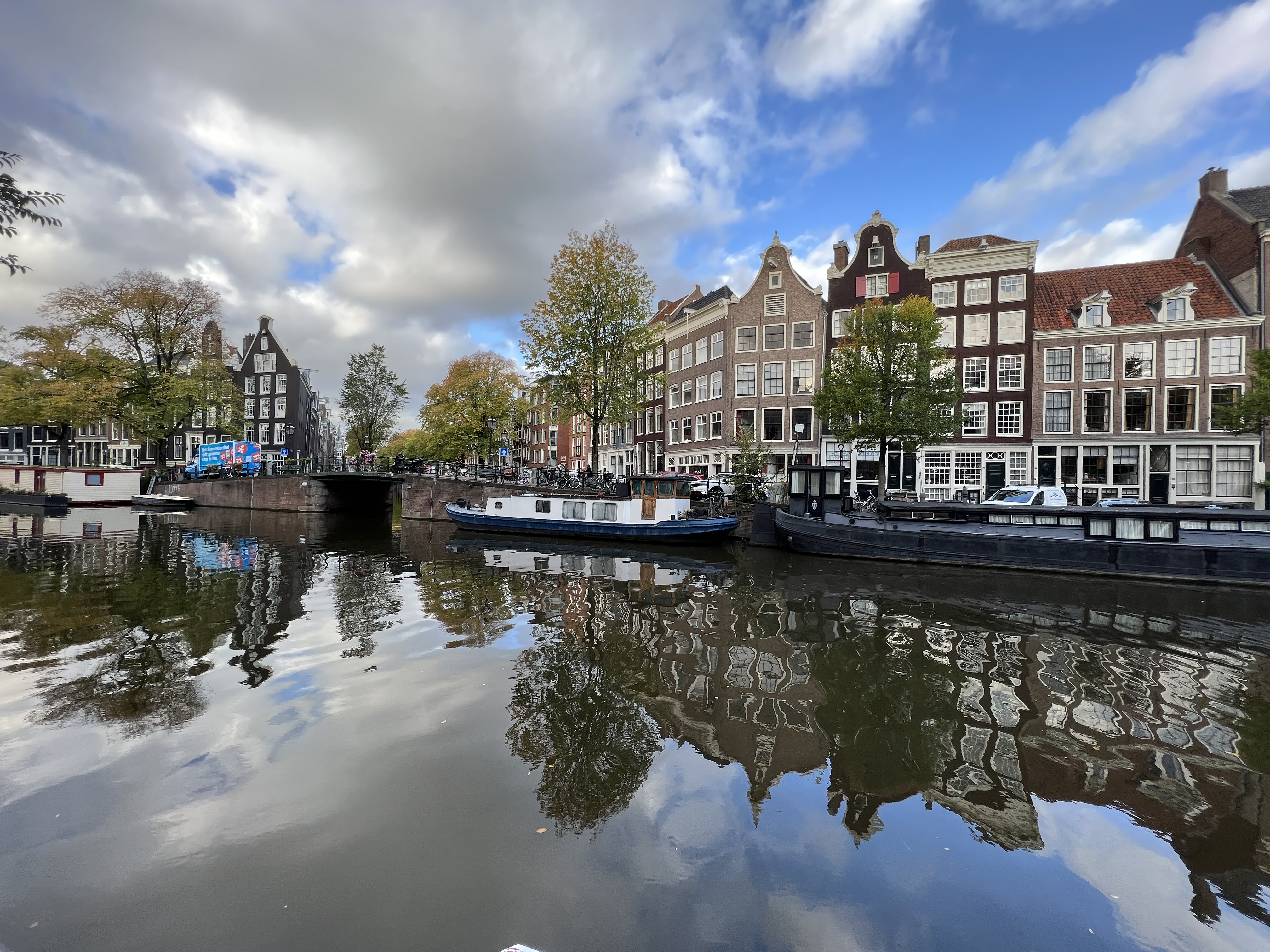
Our first stop was in Amsterdam, at the unassuming building along a pretty canal. 


The church near the house, Anne wrote about being able to hear the bells & see the tower. 


A statue near the church to Anne Frank 


Repairs on the front of the building during our visit. 


I had passed it some years before on a boat tour & even though this time it was scaffolded it was surreal standing outside & walking along the same streets which held such dark memories within living memory for some people. 

The sunshine & pretty gabled homes made it even more surreal.  I knew from her diaries that I have read several times with my students too, that she could hear the church bells & see the pretty church tower, that voices could be heard from the street, the tree in the garden - it was all familiar through her stories of the 25 months they spent in the Secret Annex. 


From there we traced their journey once captured to Westerbork Concentration Camp (still in Holland) where they were separated in to a secure space because they had been in hiding. The camp Commandants house is preserved under a glass cover, with perfect views over the train tracks & camp - the trains left regularly & an electronic board now tells of the number of people on board, their destination & the dates. A sobering reminder of the use as a transit camp. 


Transport trains arrived at Westerbork every Tuesday from July 1942 to September 1944; an estimated 97,776 Jews, Sinti and Roma were deported during the period. Jewish, Sinti and Roma inmates were deported in waves to Auschwitz concentration camp (65 train-loads totaling 60,330 people), Sobibór (19 train-loads; 34,313 people), Theresienstadt ghetto and Bergen-Belsen concentration camp (9 train-loads; 4,894 people).  Almost all of the 94,643 persons deported to Auschwitz and Sobibór in German-occupied Poland were killed upon arrival.


From there her story continues in Auschwitz but that part of the story came later for us because Anne's journey doubled back from Auschwitz to Bergen Belsen where she died.  

How bleak Bergen Belsen looked on our October morning, the sun barely warming the vast area. 


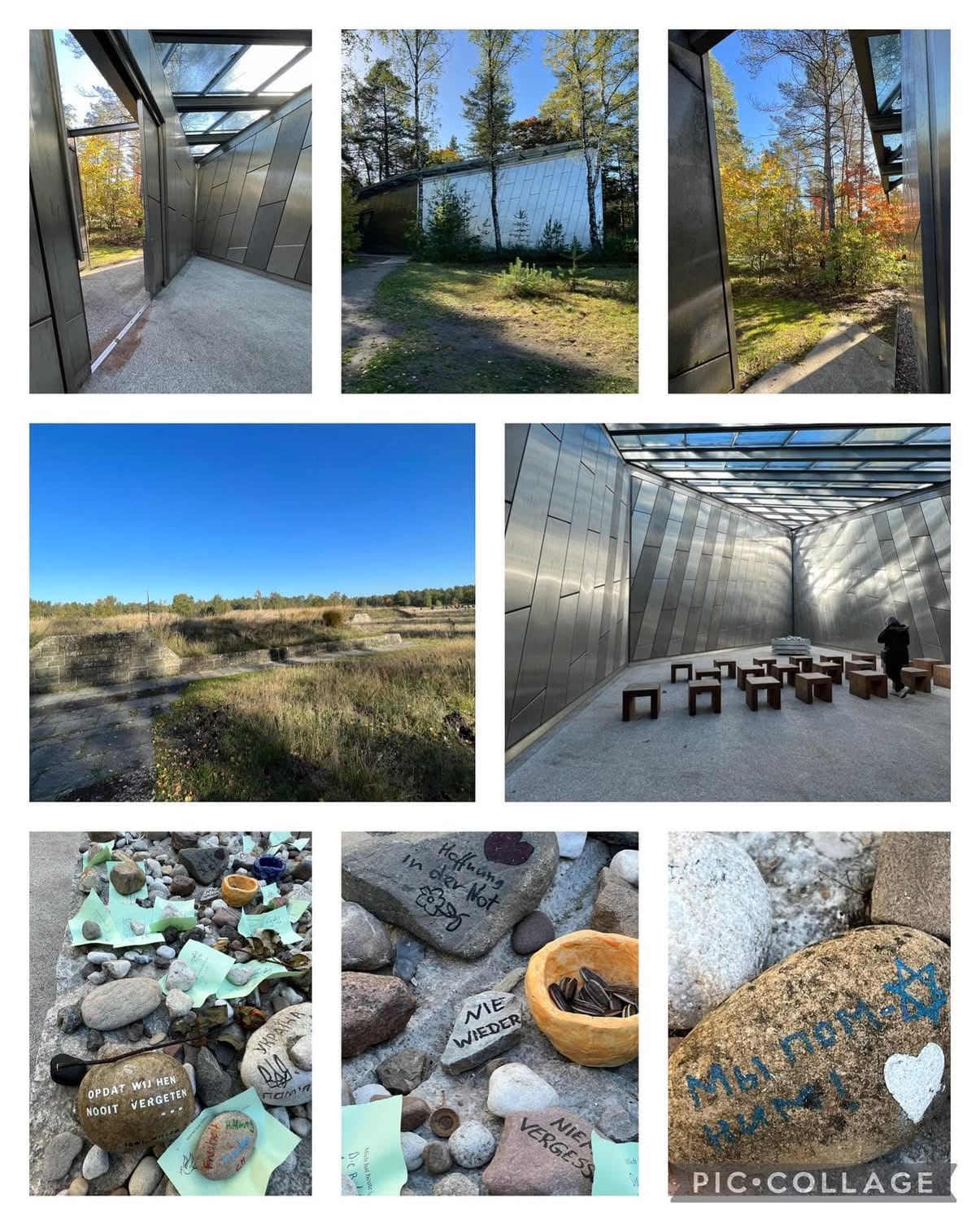
There was a real sense of despair & sadness in this vast area & the 3 ladies I was with & I retreated to the quiet chapel space along the wooded edge to gather our thoughts & selves - it is overwhelming to be moved to  silence in this place of evil.  

In this space, people had left stones with messages & we sat on the chairs & just gathered our thoughts. The weight of history is heavy at Bergen Belsen & you cannot escape the depth of the deeds that permeated this space. 


I was unprepared for the size of it & the huge brick edged burial mounds - the details given as a date & number in each mound of mass burials. Margot & Anne, the Frank sisters, like some others, have a memorial stone but their remains are contained in one of the mounds, which one is unknown.  


Stones last longer than flowers, the Jewish tradition of leaving a stone to show you have been is evident on the memorials here, people moved to marking that they had come & paid respects ... 


Nothing can prepare you for the sight of these vast burial mounds that had been pits dug to contain the huge numbers of dead. After the war, they were edged with bricks to contain them & the numbers were added to each one. There is a real sense of despair here in this space,  of history needing to be told, of death & suffering of the more than 52 000 who died there ... 
  

The excellent museum at the entrance gives much background to the Holocaust & to the life of Anne Frank, glimpses in to the life of an early Anne doing ordinary things with her friends. 

After the intensity of Bergen Belsen, we had a welcome lunch stop in Celle. It is a pretty traditional town & we could regroup & chat amongst ourselves. 

We then travelled on to Berlin, a city I have visited 3 times previously as part of general tours. I love the buzz of the city. I have previously visited parts of the war aspects of Berlin but each time I gain something new from this amazing city. I love that after several trips, I can pick out the landmarks & the streets feel more familiar. 

The story of the Nazi’s echoes across Berlin. 

I had previously visited the large stone memorial - Memorial to the Murdered Jews of Europe in Berlin - their solid shapes set on undulating paths, which gave you the feeling of helplessness, of not seeing the whole picture, of being part of something much larger.  
This time, being early morning,  our guide set us off to go alone in to this vast concrete space, to have ten minutes with our thoughts, to move about it as we wanted to & then to gather again & share our thoughts. It was interesting how everyone described the experience - some saying overwhelming, others lost, some intimidated by the tomb like structures that tower over one. It is an interesting memorial that does not tell you what to think or feel, it is open to interpretation   ....  


The new Topography of Terror museum is set along part of the Berlin wall. While setting it up, they uncovered interrogation cells along the wall that had been used by the SS during WW2. 

The information boards tell the story of how the war impacted so many communities across Berlin. Definitely worth the time there & it also has a very nice coffee shop where we could meet together at the end again as a group. 

It was then a short walk to the old railway station where so many were transported from. We passed a bunker that was set over 7 floors high, including 2 basement levels.  It is now open to the public to gain insight in to the many bunkers that protected the elite. 


A short walk from the Topography of Terror exhibition took us to a side street & then to stand on the spot of Hitler's Bunker - now under a carpark. 

 It is fitting that the bunker where Hitler died is merely marked by a board & not preserved at all, it is right not to mark this spot where so much evil was contrived from. 

Standing on the spot was surreal, knowing the history Hitler & Eva Braun. 

There was a palpable sense of walking in dark history along this walk. 

Along the Brandenburg Gate is stone markers in the pavement to show the position of the infamous Berlin Wall that separated the city, the Reich Stadt close by & the history there all contributed to how Berlin was the centre of the war.

 Walking along the remaining wall further in the city was a powerful reminder of how quickly events overwhelmed families & how quickly life can change. 

Checkpoint Charlie a visual reminder of the period after the war & how close yet how far the communities were in their divided state. 


More to follow ... 

Dee