Showing posts with label NC500. Show all posts

Saturday, 24 August 2024

A finished scroll of our NC500 trip ...

 I love a summer holiday project or two or three when my students & I have a break from each other & it is a luxury to fill time as I please. This year, due to commitments, we have not taken an overseas holiday but had a wonderful 10 days exploring the North Coast of Scotland on the NC500 route. read all about it on the previous posts with links here 

I shared that I had decided to do a sewing scroll on a long 1.5m linen fabric length, originally just as a small scroll. However, once I got started, I realised how much I was enjoying the randomness of just doing it that soon the whole scroll was covered in stitching doodles. 

We often have the idea that creative work has to be 'perfect' but there is so much more joy (in my opinion) in the imperfect creative act where the process forgets about judgements & fear about 'is it good enough?' and just goes with the pleasure to create something that has no purpose other than to give pleasure to the one making it.  Comparison & perfection is the thief of joy so it is best to just go where the process takes you. Sometimes it is about stepping out of your comfort zone & trusting your intuition. 


I made a conscious decision not to add fabrics to the scroll itself because it is a huge distraction for me to select fabrics from my generous stash & I get too side-tracked or overthink the colours etc which means everything grinds to a halt. 

I decided on thread stitching only but added details with the sheep wool I picked off a fence & the shells I found on the beach along the way because they belonged to the journey.  A large shell & piece of driftwood I picked up on various beaches was set aside for the scroll handle. 


I found a lovely bit of fabric in my stash with the same colours with a scene of trees & sheep & decided to machine embroider some of the place names to attach to the end of the scroll. After an initial mishap when the bobbin thread bunched up & had to be cut loose & unpicked, it went well & I managed to  do many of the place names with just one spelling mistake (you have to select all the characters for each word & save before it stitches so it can be tricky as you don't see the whole word together ...) The green thread was a good, gentle choice & the colour doesn't jar ... 


I bought in a piece of pale lilac linen from a trusty ebay seller I use for my linen bits & decided I wanted to hand stitch it to the scroll front. None of my threads looked just right but on a trip to our county town of Shrewsbury, I saw a variegated thread & knew it was the perfect colours.  Blanket stitch uses so much thread that I bought 3 lots but used up a whole one only. The rest will be used on other things as it is lovely colours. 

The edges were done with 3 strands of this cotton in blanket stitch to hold the various layers together,  then the decision on how to attach it. The end fabric was merely rolled over, the drift wood attached by stitches at the top & bottom then the large shell attached to the driftwood & scroll. Easier than I anticipated. 


The scroll will roll from the one end to the drift wood / shell side & ties with a 'made in Scotland' ribbon I already had. 

I am rather pleased with it, a project purely for my own joy & that is surely the best way to doodle with thread. I hope you have enjoyed the journey with me. Thank you for stopping by, 

Dee ๐Ÿชก๐Ÿงต๐Ÿš๐Ÿš™

Sunday, 11 August 2024

Going where the needle takes me on a NC500 sewing scroll ....

 I hope you enjoyed some previous posts about our recent trip exploring the North Coast of Scotland ... 

I often blog (alongside a travel journal) so the details are at hand for future reference. 

This was our NC500 Scottish trip = 

#1 - Exploring Scotland's Black Isle

#2 - Easter Ross along the coast

#3 - Wick & Sinclair castle

#4 -  The North Sea & coast of Scotland

#5 - Western Sutherland to Ullapool

#6 - Wester Ross to Skye

#7 - Crossing paths with the Picts in Scotland

After a busy year of working closely with pupils & their families as an Elective Home Education tutor, I like to take time to just clear the mind completely in our summer break before new academic diaries are filled with the overflow from the previous year. 

This year we do not have an international holiday booked so can enjoy the luxury of filling the day as I please & that is a huge privilege & pleasure for me. 

I have several sewing projects on the go, a monthly circular stitching one, a 100 day one (that has faltered as I have done other things)  and on a whim I took a length of white linen (that I use for many projects, I decided to start a Scottish scroll.  

     
There was no plan; just doodling with needle & thread to see where it goes, trusting your skills to take you where it will. That is the best sort of stitching for my intuitive mind. I am not a pattern follower at all, I like to just make it up as I go along & this is what I did. 


I moved some threads, cottons, a hoop & bits to the conservatory table which has a lovely view of the garden & then looking at my trip photos & a book we used along the way, I lightly sketched out some outlines with a frixon pen (heat erasable pen used in sewing) and decided I wanted to outline in black. I was not even sure I wanted to fill in, just stitched & outlined as I went along, completely without thought to scale, placements or timeline - just stitching for the pleasure of the repetitive nature of thread through fabric which is almost meditative. 

Somehow the outlines filled up the 150 cm fabric scroll, my interpretation of the scenes I had encountered & enjoyed. It is  intuitive, primitive stitching, none of the perfect scenes that are found commercially. I do not consider myself to be a textile artist, just a lover of textiles & art. 

My mother was a great embroiderer & sewer, as was her mother & grandmother.  They were more precise with their stitches - there was no quick online search to remind you of stitches etc somehow they were ingrained in their minds.  Their work was as neat on the back as the front but their work had purpose - tray & table cloths, clothes, crochet doilies, bibs for babies, covered coat hangers, cushions, sports bags - they did not baulk at making anything.

My sewing is more for pleasure now (though I did a special harvest apron recently) & I often browse instagram & pinterest for ideas & inspiration but that can be limiting because you get bogged down in too much detail & that hinders the doing. 

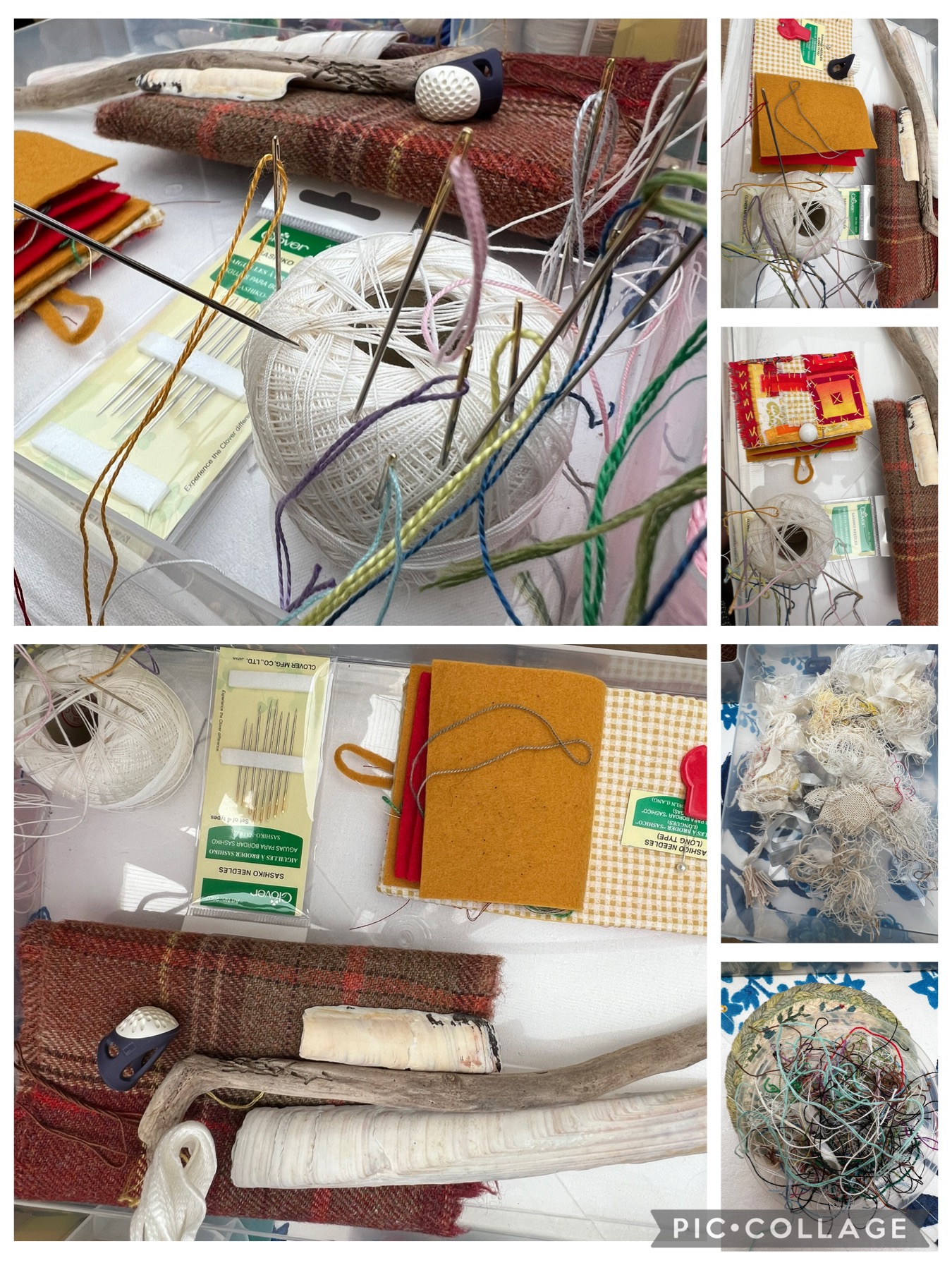
This is the conservatory where I have been working - the long rectory table taken up by beads, a felting sponge & stabber, multiple containers of threads of all sizes & colours, & of course multiple needles. 

Who else has loads of needles loaded up with all sorts of colours at the same time? 

I decided that I did not want to add fabrics to this scroll - I wanted the details to be in threads only. The reason being that fabrics would introduce too much choice & distraction again -   you know how you get side-tracked looking for a particular book then sit on the floor with books you have rediscovered? Fabrics are the same - too much choice is distracting. 

So I just dipped in to the container of threads & used threads for the details - lots of choices of shades in the various colours - a challenge to think of stitches for each part (a simple running stitch can be so versitile) & then trusty favourite stitches I use like French knots, fly stich, whipped running etc 

At Sinclair castle, I had pulled some sheep fur from the wire as we walked back along the windswept coast & I picked up another little bit of darker wool near Ullapool so I outlined some sheep & felted in the bits of wool I picked up. 

I picked up a large straight shell, some small drift wood & other shells on the beach at Dunnet Links, Strathy & Farr beaches & at Skerray Bay, so I decided to add a  beach to the scroll.  Some of the sheep wool was again felted / jabbed on to the linen as the soft, white sands of those stunning beaches & then beads were added.  Beading is best done in good light as the needles are so thin & the thread is fine too but the effect is worth it. 

Because the scroll was unplanned, the width is too big for my vintage wooden bobbins - however, the driftwood & shell will make good bobbins to wind the work around. That is the final step - backing the untidy reverse side with a lovely soft purple linen which will be handstitched to the 150cm scroll & attaching the driftwood support parts. 

You will have to come back for that finished bit in about a week. 

What is keeping you busy at this time - tell all. Thank you for your company, it is always appreciated. 

Dee ๐Ÿšฃ‍♀️๐Ÿš™๐Ÿชก๐Ÿงต๐Ÿงถ ๐Ÿš๐Ÿฆช๐ŸŒŠ⛰️

Thursday, 27 June 2024

NC500 #8 Isle of Skye


I hope you are enjoying travelling along with me on the NC500 - North Coast 500 Scottish trip. 

I shared the lovely route along Wester Ross with the Isle of Skye within close distance, accessed just by a crossing bridge. 

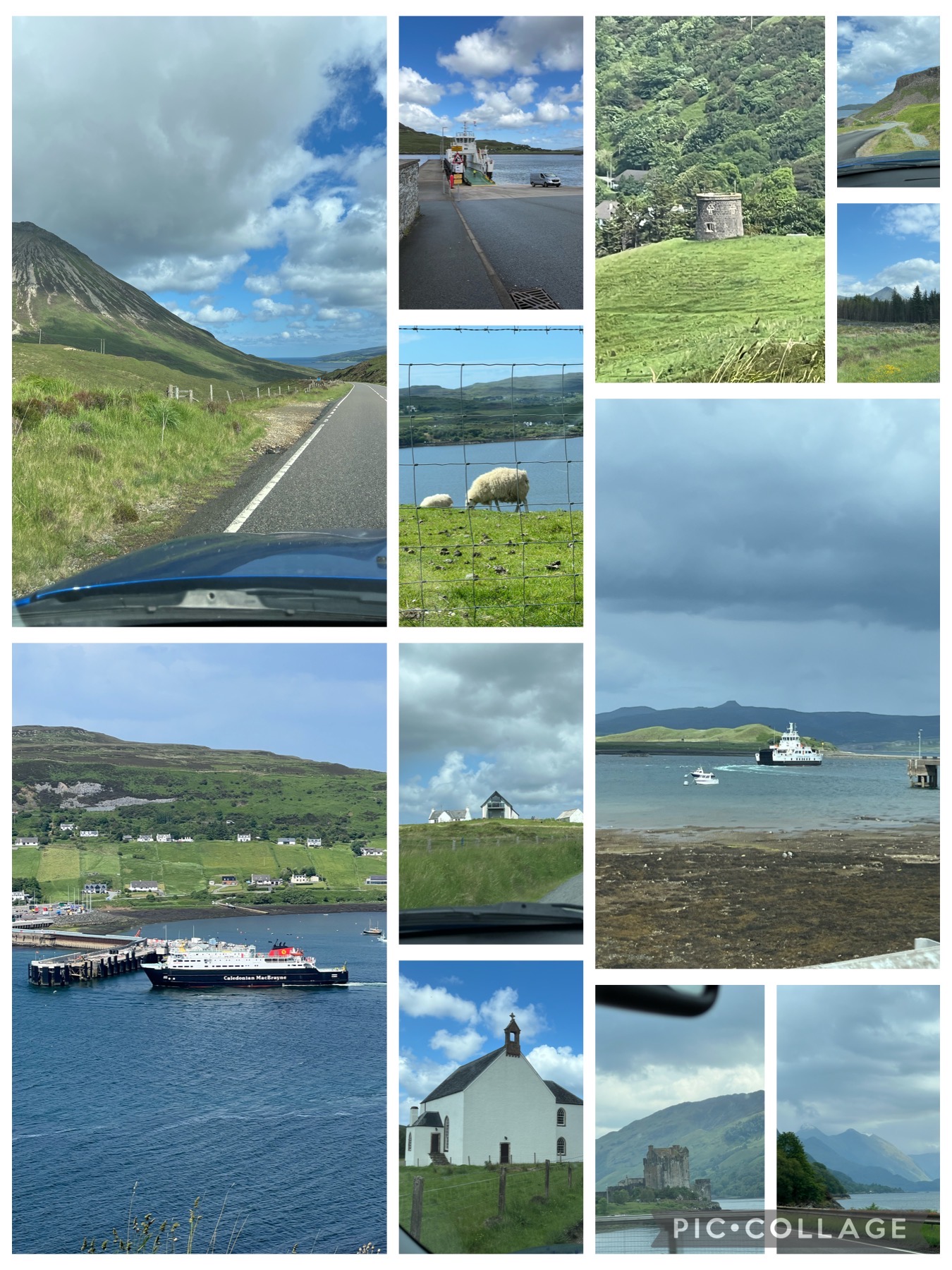
LochCarron  is just a close hop over to Skye. The pretty ride along the side to the bridge took us along the Loch, then on Skye, we took the turn for Armadale Castle & gardens. 

What a delightful spot with the ruins of the castle set in stunning grounds. 


The estate was the clan home of the Clan Donald. The Museum of the Isles had a comprehensive history with interesting artifacts & a great welcome team on hand to impart knowledge. There was also very good information on The Picts who inhabited these islands & the mainland. 


We then doubled back & did the main loop around Skye with the narrow passing places, beautiful coastline & little harbours. We stopped off in several places & realised it is a place that you really need to spend a few days to explore properly & enjoy the history & scenery. 

The fresh air & sea views were just wonderful. 

Back on the mainland, we headed for Fort William  in the Scottish Highlands. The road around Loch Ness was narrow in places & several places were too tight for passing busses which resulted in much shuffling back & forth until the road could clear.  Ben Nevis looms over this landscape in all its glory - a reminder of the beauty of Scotland. 

Our Fort William hotel was opposite the Loch & we had a very comfortable room, an appetising supper & a lovely walk around town & the loch. 


The trip back to England took us past Glasgow & we decided to pull in at the New Lanark World Heritage Site. 

The mills of the north are well known & this heritage site pays homage to that period of history as it has a water wheel set along the River Clyde. 


The importance of Robert Owen is well set out in the school, the mill, the millworkers modest house, his home, the exhibitions & the institute. He was a man of vision. 


We had a fascinating find to see a link to Robert Owen & the Tolpuddle Martyrs of Dorset that connects to my Husband's family. 


All too soon it was time to head to Cumbria again on our way south to The Midlands. What a fascinating time in Scotland on the North Coast500 - I am acutely aware that we only scratched the surface of this amazing country, it left us wanting to see more & so a return trip will be needed. 

I hope you have enjoyed this trip, thank you for stopping by, it is always greatly appreciated. 

Dee 

Wednesday, 26 June 2024

NC500 #6 Wester Ross to Skye

The next leg of our trip around the north western coast of Scotland was dramatic. 

Wester Ross did not disappoint with its steep roads, long lochs, traditional Applecross village & then the challenging Bealach na Ba pass. The weather turned cooler & the mountains had a dusting of snow on them. Some heavy rain set in too & we were glad of our flask of coffee & some biscuits while we stopped at the various lookouts ... 

Leaving Ullapool & driving along the pretty Loch Broom with its windy road, you soon realise that these steep mountains & glens are not far away, with the towering peaks & falling waterfalls.  It has its fair share of small fishing villages & stunning white sandy beaches.

I knew something of the Russian Artic Convoy units of WW11 who were tasked with keeping the northern passage open from Scotland to Russia. It was under very challenging conditions because it is in the artic circle & the ships were breaking winter ice, they were being bombarded by the Nazi's & it was a really tough time. These service people campaigned long & hard for their own war medal & this was eventually granted in 2015, about the same time as the Land Army women were granted their own medals too. 

We stopped at the Artic Convoy museum & it was an interesting experience to learn more of this exemplary unit.  Loch Ewe was an important Scottish port for the Artic convoys & the harbour / cove had special metal circles strung across the entrance to stop u-boats coming in to the harbour. We stopped along the road at several places where signboards showed more of this important time.  


Loch Ewe still maintains its important naval link today

Loch Ewe today
Nowadays Loch Ewe still has a naval presence, there is a NATO fuel station near Aultbea where naval vessels can refuel and in Mellon Charles is a small Navy depot. Most buildings that were used in WW2 are still present today. The most impressive site is north of Cove, at Rubha nan Sasan. Here are a lot of buildings overlooking the Minch and Loch Ewe including a memorial with the following inscription: “In memory of our shipmates who sailed from Loch Ewe during World War II. They lost their lives in the bitter arctic sea battles to north Russia and never returned to this tranquil anchorage. We will always remember them.” Other remains of the wartime military presence can be found near Tournaig Farm, in Aultbea and at the end of the road at Mellon Charles. The NATO is still using Loch Ewe as an exercise area, usually in spring and autumn.

These peaceful, pretty harbour villages show that fishing on a modest scale is still done 

Strome castle is another small, ruined 15th century castle that was once owned by Alexander Macdonald, Lord of the Isles & Earl of Ross. It changed hands between several clan families before it came to be in the present state:
In the aftermath of the Battle of Morar which took place in 1602, the castle was besieged by Kenneth Mackenzie, 1st Lord Mackenzie of Kintail, chief of the Clan Mackenzie, assisted by their allies the Clan Matheson and Andrew Munro of Novar. After the MacDonells surrendered it was demolished and blown up. The MacDonells of Glengarry built a new castle further inland called Invergarry Castle.

We gingerly made our way up to it & enjoyed the elevated view then walked down to the small slipway to the loch. The large wooden green boat was definitely not going anywhere. 


Shieldaig is a little harbour village with pretty white buildings, a peaceful setting. However, it is one of the many towns along this coastline with a strong military connection because of their proximity to the northern coast & sea routes. This remote village was developed in the 1800s to train seamen for the war against Napoleon. The forests around it provided trees for warships & the hidden cove was a perfect place for the training. It affords good views over to Loch Torridon & this rugged landscape has a charm of its own. 

I have been to the Victoria Falls that is a between Zambia & Zimbabwe, it is a fall that is known to generations of my family so seeing mention of another Victoria Falls demanded a stop. The Guidebook Destination NC500 incorrectly places the original falls in South Africa ... 

This Victoria Falls was visited by Queen Victoria in 1877 & is accessed by a flat walk to a viewing platform. It was pretty but not remarkable, definitely not the Smoke that Thunders of the Southern Africa one but it was an opportunity to stretch our legs & visit it. 

The Applecross pass or Bealach na Ba was a rovers track in times gone by where cattle would be moved from the highlands down. 

The historic mountain pass was built in 1822 and is engineered similarly to roads through the great mountain passes in the Alps, with very tight hairpin bends that switch back and forth up the hillside and gradients that approach 20%. It has the greatest ascent of any road climb in the United Kingdom, rising from sea level at Applecross to 626 m (2,054 ft) in about 6 km (3.7 mi), and is the third highest road in Scotland. (Wiki) 

The roads leading to it are a taster of what is  to come with twists & turns & stunning views of the mountains as the road changes direction. It reminded me of the mountain passes we travelled monthly from our remote community in  Lesotho. 

The pass is a steep single track with small passing places along the way, many of the passing places just enough for 1 vehicle to pull in. It is definitely not suitable for nervous drivers or large camper vans that are widely seen on this route. We had 2 motor bikes that passed us numerous times, they stopped or we stopped to do  photos then we let them pass again so they could have the benefit of the spectacular views without being stuck behind a tall vehicle.  There are many black tyre tracks along the steep parts as vehicles obviously had to brake hard while descending or waiting for oncoming vehicles. 

We stopped for the night in Lochcarron, a little seaside town that was hospitable but not remarkable (though hubby was impressed with their golf course that you drive through) 

The day's planning over breakfast decided that since we were so close to the Isle of Skye, it would be our trip for the day.  The road was another beautiful loch side trip to the bridge connecting Skye to the mainland, but that deserves its own post. 

Thank you for taking time to visit, like, comment or share, I really do appreciate it.

Dee ๐ŸŒŠ๐Ÿšค๐Ÿš™๐Ÿด๓ ง๓ ข๓ ณ๓ ฃ๓ ด๓ ฟ

Wednesday, 19 June 2024

NC500 #5 Western Sutherland to Ullapool

After a very comfortable night & wonderful breakfast in Tongue, the Kyle of Tongue bridge took us out of town  towards the causeway & a beautiful scenic & we came across the most perfect (in my mind) harbour & lighthouse. 


We stopped at the top & looked down on the most beautiful white crescent sands & a few boats bobbing along near it - a double beach. It looked so idyllic that it was hard to tear myself away & the photos do not do it justice. 


This area is known for a dark period of history - the Highland Clearances, forced evictions of thousands of tenant farmers & their families. It is a complicated  time in Scottish history that I am not fully up to speed on so the info on the link is probably the best history. 

This north western part of Sutherland is stunning. 


The gift of time is wonderful; we booked hotels that we not too far apart so we could have a full day to explore between them, especially as the coast is so fascinating.  There is always so much to see & do that you have to just decide what you want from each stretch, it leaves you wanting more ... 

Smoo cave is a must stop, a unique cave accessed by a long path down to the beach below. 


There is a very good overview of its position in this image - a unique cave worth the visit & steps 

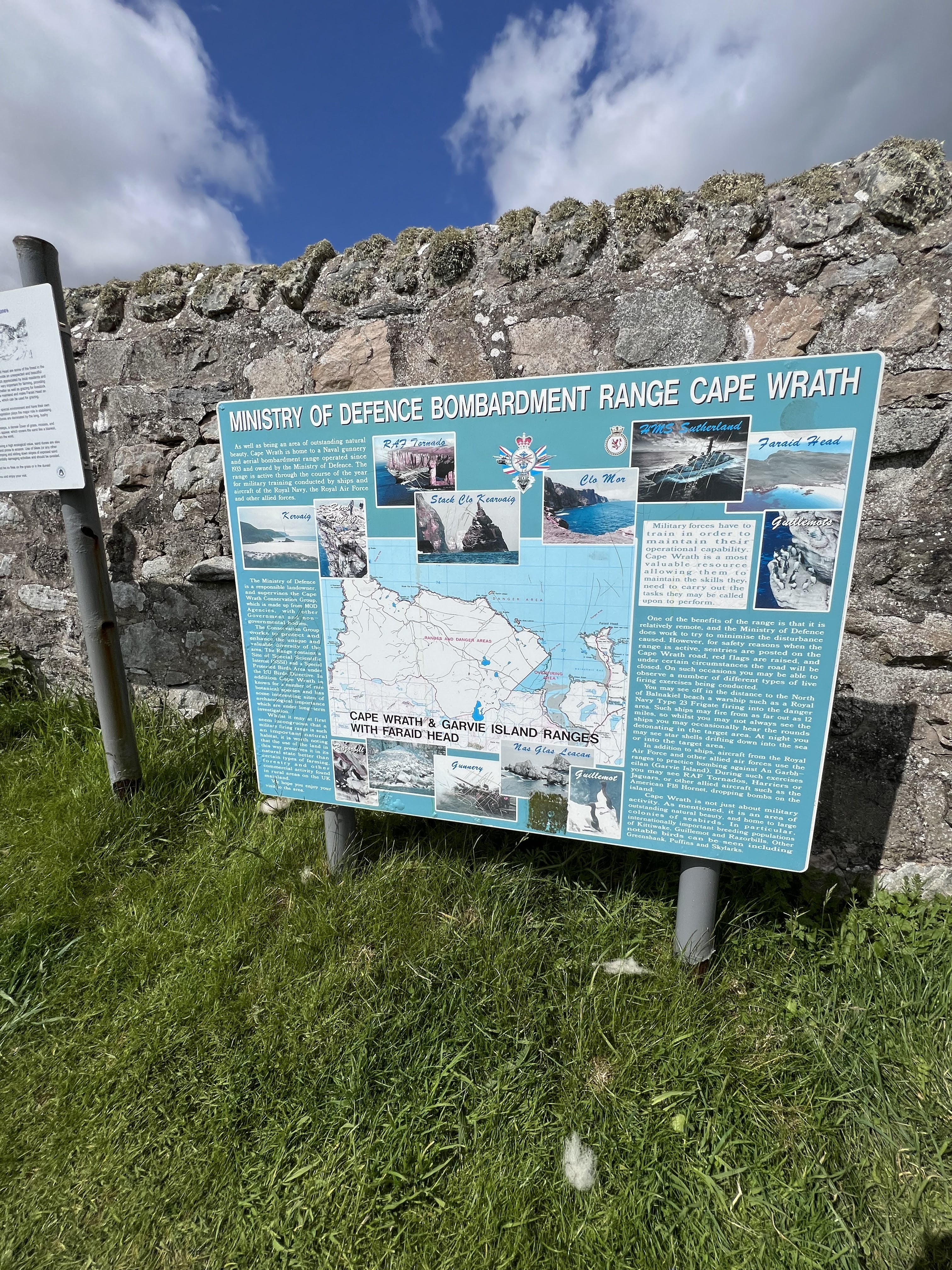
On the Durness coastline, we stopped at Balnakeil & the ruined church & graveyard. It is an interesting place with the MOD occupying part of Faraid Head where there is an abundance of wildlife & coastal birds as well as seals. The Scottish poet Rob Donn is buried in this graveyard. 


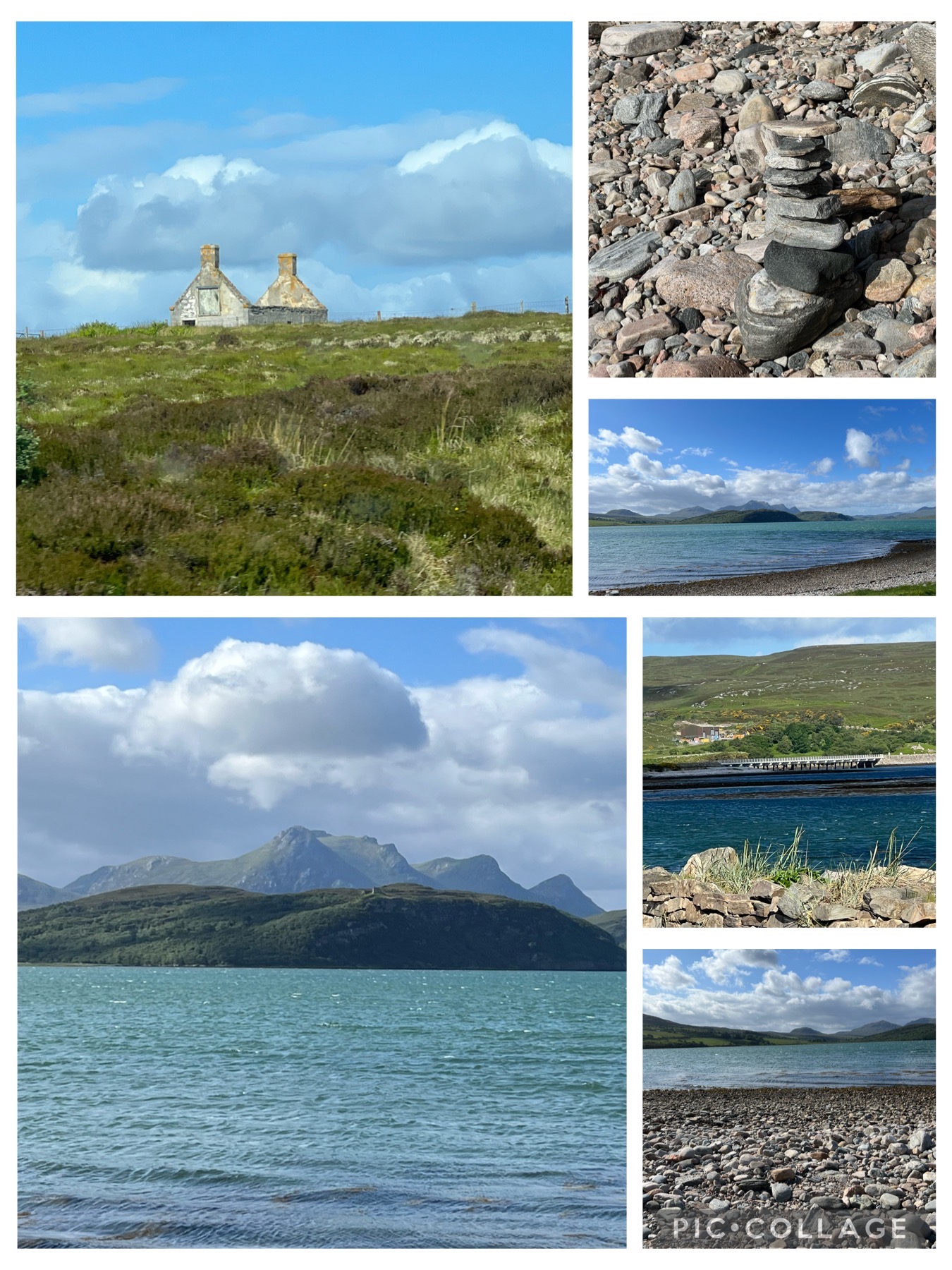
A beautiful stretch of beach lies below the church, another pristine sandy one with beautiful turquoise waters. 


Castle Ardvrek is another landmark castle along the way - I decided to take photos of the names on the map because you start to forget which is which along the way when there is so much to see. It is perched on an island, accessible only by a narrow band of shingle beach. It was originally built by the MacLeod's of Assynt in 1590 & is said to be haunted by the weeping daughter of the Macleod chief.  
It was absolutely tipping down with rain so we did not walk to the castle but stopped at the lookout to enjoy it. However, it was interesting to see a small rowing boat with 2 people in it out on the choppy waters, like time stood still.


This coastline again has such stunning crescent shaped coves & beaches but the weather was turning & we did not have the sunlight to do it all justice. 

Kylesku Bridge is a known landmark & it is impressive, worth stopping at the pull in before to appreciate the engineering & beauty of it with the Assynt mountains behind it. It was only built in 1982 but has been recognised as a innovative structure. You do not fully appreciate it when driving over so the look out stop is essential (along with a coffee & something sweet at the catering van there)  


The weather had turned & it highlighted the dramatic landscape of high mountains, many with snow now & the deep valleys with intense greenery. 


The Old Man of Stoer lighthouse & stacks were another impressive stop, they are a real landmark along this coast too. 


The Stoer Head Lighthouse is a beacon with its white structure & yellow details.  Lighthouses are always perched up high & this means the winds really get up & you can appreciate the rough seas & rocks below. It is dramatic looking out on the wild seas ... 


No seaside stay is complete without a walk around the harbour & a fish & chip supper. I am rather partial to fish & chips at the coast & this was a very generous portion that hubby helped me finish (he had fish too, but not with chips so he was happy to help out.) 

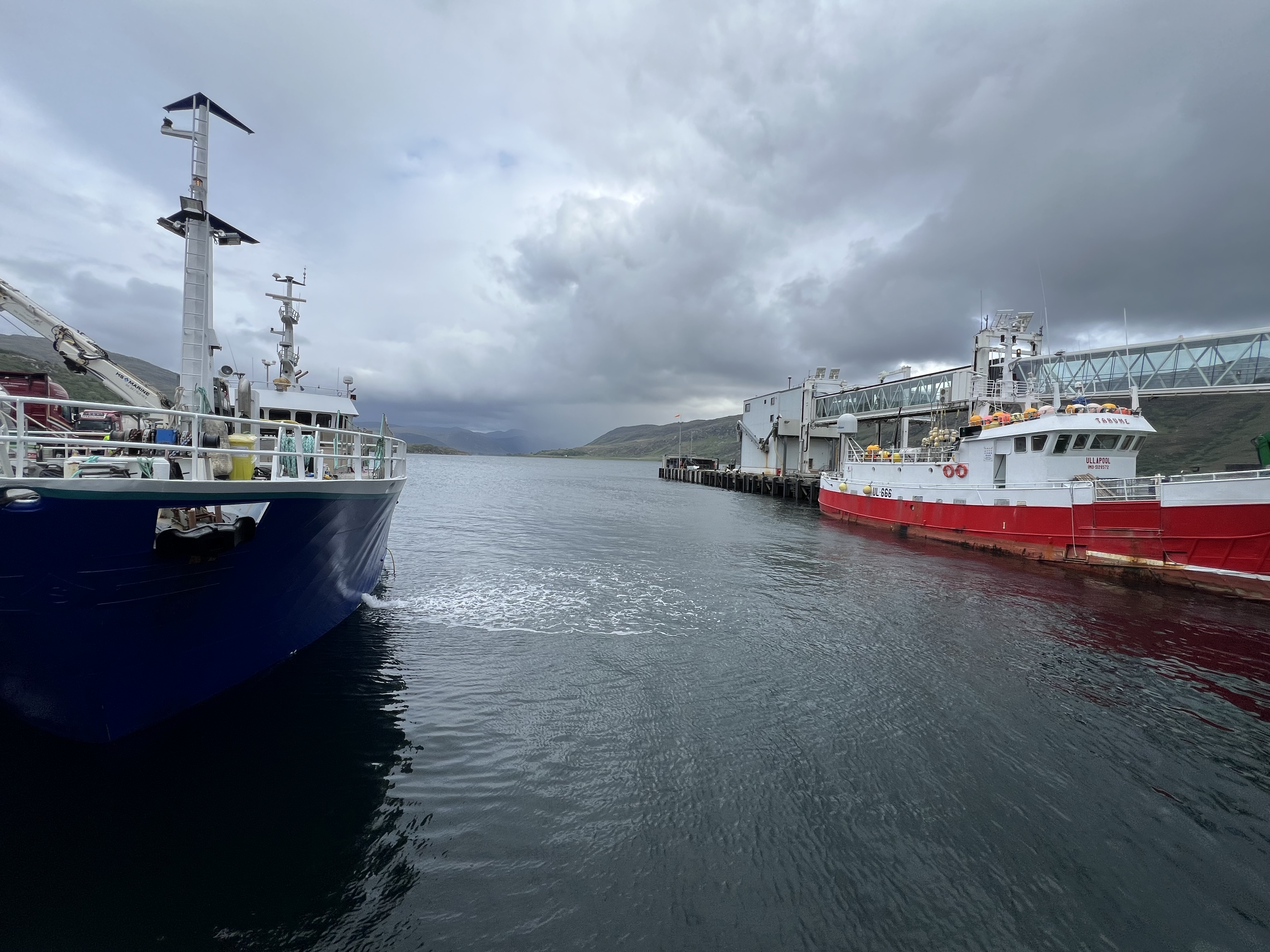
Ullapool, like many towns along this coastline,  is a ferry port to the various Islands, this one to Stornoway & the outer Hebrides. Several guests at our hotel were up bright & early to catch the morning ferry after breakfast. 

Ullapool was founded in 1788 & the port was designed by the famous Scottish Engineer Thomas Telford (also designer in Wick) 


Leaving Ullapool, you drive along the picturesque Loch Broom with its windy road & impressive mountains. To be continued, do follow, share & enjoy, 

Dee ๐Ÿ›ณ️⛴️๐Ÿšฃ‍♂️๐Ÿšค⚓️